
China protectionism is the set of rules, taxes, and policies China uses to shield its industries from foreign competition, and the same term now describes what other countries do to China in return. The global economy can be hard on individual countries. In a slowdown or recession, and sometimes in ordinary times, a country’s industries face competition they cannot yet meet, and its government faces pressure to do something about it.
A country restructuring its economy, or catching up to more developed competitors, feels the same pressure regardless of the world economy’s condition. The tool governments reach for is protectionism: rules, regulations, and taxes intended to protect domestic industries from foreign competition. The measures themselves are called barriers to trade, and this article covers what they are, why countries use them, and how China protectionism, and protectionism against China, has changed.
Forms of China Protectionism
Tariffs raise the price of imports to shift demand toward domestic goods. Non-tariff barriers such as quotas limit imports by volume rather than price. Voluntary export restraints are quotas negotiated between two countries. Administrative barriers, standards, licensing, and certification requirements, restrict imports without appearing to.
Subsidies protect domestic producers by lowering their costs rather than raising the importer’s. And industrial policy, direct state support for chosen sectors, is protectionism’s most ambitious form: it does not keep foreign goods out so much as build a domestic industry to replace them. Controlling imports is the aim of most protectionist measures; controlling exports of strategic materials and technology is the newer form, and the one China protectionism now leans on most.
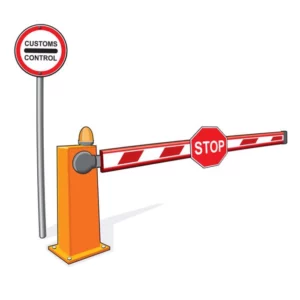
Tariffs are the visible form of protectionism. Most of it is less visible.
The Effect of China Protectionism
Economists and politicians generally favour free trade, but that does not settle the case against China protectionism, which has real arguments on both sides depending on the sector and the stage of development.
The strongest argument for China protectionism is the infant-industry argument. A new industry in a developing country cannot compete with established foreign producers who already have scale, skills, and infrastructure; without protection, imports will saturate the domestic market before the domestic industry has a chance to develop. On this view, protecting the industry until it can compete is only fair. China’s development from the 1980s is the most successful application of that argument in history, and the countries now trying to copy it, from Vietnam to India, are following the same logic.
The argument against China protectionism is that protection hurts the people it claims to help. The principle of comparative advantage says the gains from free trade exceed the losses, because countries specialise in what they do best, and that competition raises living standards. Protected industries may never become competitive, and the consumers paying higher prices to protect them bear the cost indefinitely. Barriers can make sense in specific circumstances, but as a general policy they leave every country worse off.
The Development of China Protectionism
Protectionism has been rising worldwide since the 2008 financial crisis, and China is the country most often on the receiving end. That is only part of the picture. China protectionism took a different form from the tariffs used against it: strong incentives for its exporters, including VAT rebates and subsidised land, credit, and energy for state-owned and favoured firms; compulsory joint ventures and technology transfer as the price of market access for foreign companies; and heavy protection of the domestic market in strategic sectors. That combination allowed China to catch up and then lead in sectors from solar panels to electric vehicles, and it is the basis of the countervailing-duty cases the EU and US bring against Chinese products.
Since 2018 the picture has changed on both sides. The United States imposed Section 301 tariffs on most Chinese imports in 2018 and 2019, added further layers from 2025, and imposed export controls on advanced semiconductors and chip-making equipment. The EU applied countervailing duties on Chinese electric vehicles in 2024.
China responded with tariffs of its own on US goods, and, more significantly, with export controls: licensing of gallium, germanium, graphite, and, from 2025, rare earths and rare-earth technology, the materials on which foreign electronics and defence industries depend. What was a trade dispute has become a contest of industrial policies, with each side using the levers it holds.
At the same time China protectionism has loosened where openness serves China’s interests. The 2024 edition of the Negative List for foreign investment removed every remaining restriction in manufacturing, ending the compulsory joint venture in that sector, and the 2026 Tariff Adjustment Plan cut import duties on 935 tariff lines of advanced components and materials. The pattern is consistent: China protects the sectors it is building and opens the sectors where it wants foreign capability, and it uses export controls as the counterweight to tariffs imposed against it.
The World Trade Organization was designed to arbitrate this kind of dispute, but its dispute-settlement process has been effectively paralysed since 2019, when the United States blocked appointments to its appellate body. Cases are still filed and panels still rule, but a losing party can appeal into a void, and a measure can stay in place for years without resolution. The WTO remains the framework for tariff schedules and trade rules; it is no longer an effective referee.

Protectionism now runs in both directions, through tariffs one way and export controls the other.
The Future of China Protectionism
Most economists still hold that China protectionism, like all protectionism, damages the global economy, and the logic has not changed: a country that imposes barriers may gain in the short run, but its trading partners retaliate, and once everyone is protecting, everyone loses. What has changed is that the largest economies have decided the logic does not apply to strategic sectors, semiconductors, batteries, critical minerals, and pharmaceuticals, where security and resilience are judged to outweigh efficiency.
That decision is not going to be reversed soon, and it means the barriers now in place between China and the West should be treated as the environment rather than a temporary disturbance.
For a company sourcing from China, China protectionism and the Western response to it have three practical consequences. Tariffs in your home market are now the largest single variable in landed cost, and they change with policy rather than with markets. Export controls in China can interrupt supply of specific inputs, and a product that depends on a controlled material needs a plan for that.
And the “China plus one” strategy of producing in China and assembling elsewhere is no longer a hedge but a standard structure, which makes where a product is made a design decision. Working out that structure for a specific product, including which country it should ship from and what it will cost to land, is part of what our product sourcing service does.