Bottled water is a universal commodity, and PET packaging use follows it. Polyethylene terephthalate is the most widely used plastic packaging material in the world, and water alone accounts for around a third of global PET packaging consumption, with carbonated soft drinks taking another quarter. PET packaging use is driven by the material’s combination of properties: it is strong, light, clear, cheap, and, unlike most plastics, genuinely recyclable into new bottles. Global plastics production reached 430.9 million tonnes in 2024 (Plastics Europe), and PET is among the largest single resins within it.
PET packaging use spans bottles, jars, trays, and containers for beverages, food, personal care, and household products, sold to households, restaurants and cafés, and industry. Concern about single-use plastic has not slowed it: convenience and cost keep demand growing, and the recycling story is better for PET than for any other plastic, though still far short of what is claimed for it. Global collection rates for PET bottles vary widely by country, from over 90% in deposit-return systems to under 20% where no collection system exists.
Distribution of PET Packaging Use Worldwide by Sector
PET packaging use divides across end-use sectors roughly as follows, based on Euromonitor data for global consumption:
- Water: around 34.6%. The largest single sector by a wide margin, and the one growing fastest in developing markets where tap water is not trusted.
- Carbonated soft drinks: around 27.1%. PET replaced glass and aluminium in most soft drink formats because it is lighter to ship and cheaper to fill.
- Other drinks: around 11.2%. Juices, sports and energy drinks, iced tea, and dairy drinks.
- Non-food products: around 12.1%. Personal care, household cleaning, and cosmetics packaging.
- Food: around 8.4%. Sauces, oils, condiments, and dry goods in jars and bottles.
- Thermoforming: around 6.6%. PET sheet formed into trays, punnets, and clamshell packaging, which is the fastest-growing PET packaging use outside beverages.
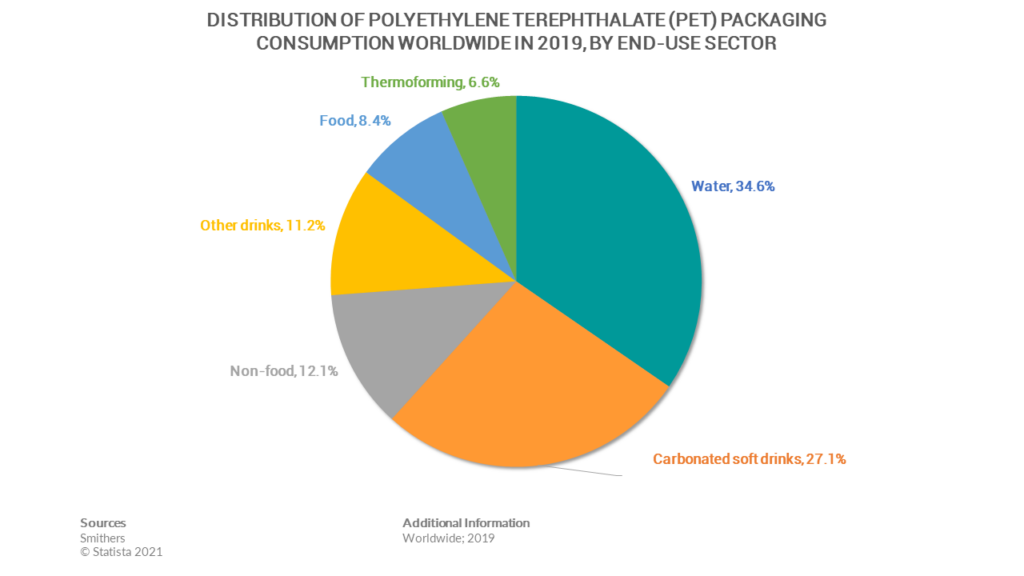
PET packaging use by end-use sector. Water and carbonated soft drinks together account for over 60%.
Largest Regional PET Packaging Consumers
Asia-Pacific is the largest regional consumer of PET packaging, at over a third of global consumption, driven by population, rising incomes, and bottled water demand in China, India, and Southeast Asia. North America is second, and Europe third. The regional split matters for a brand because it determines where PET packaging is cheapest to buy and where regulation on it is tightest: Asia has the capacity and the price, Europe has the strictest rules, and the two are increasingly in tension for anyone selling in both.
The Expected Future of PET Packaging Use
PET packaging use will keep growing, and its composition will change. Three forces are reshaping it.
Recycled content requirements. The EU’s Packaging and Packaging Waste Regulation and its Single-Use Plastics Directive require minimum recycled content in PET beverage bottles, rising over the coming decade, and several US states have set their own targets. That has turned recycled PET (rPET) from a marketing option into a specification, and demand for food-grade rPET now exceeds supply in Europe, which has raised its price above virgin PET, an inversion that would have seemed impossible a decade ago.
Deposit return schemes. More countries are introducing deposit systems for beverage containers, because they are the only mechanism that reliably collects bottles at the rates recycled-content rules require. Where they operate, collection rates rise above 90%.
Lightweighting and design for recycling. PET bottles have become steadily lighter, and the industry has moved toward mono-material designs, clear resin, PET-compatible labels and caps, that can actually be recycled. Coloured PET, sleeve labels, and mixed-material closures all reduce a bottle’s recyclability, and regulation is increasingly penalising them.
Why PET Packaging Demand Keeps Growing
PET’s properties explain its position. It is strong enough to hold carbonation, clear enough to show the product, light enough to cut freight cost against glass, cheap enough for single-use, safe for food contact, and recyclable back into food-grade material, which almost no other plastic manages at scale. Stretch blow molding, the process that makes PET bottles from injection-molded preforms, is fast and cheap at volume. For most beverage and many food applications there is no alternative material that matches it on all of those at once, which is why PET packaging use has grown through two decades of pressure against plastic.
The Role of Distributors and Converters
Most brands do not buy PET resin; they buy preforms, bottles, or finished packaging from converters, and the converter’s choices, resin grade, preform weight, neck finish, recycled content, decide the cost and the compliance position of the packaging. A good converter will advise on lightweighting, on which closure and label systems keep the package recyclable, and on how to meet the recycled-content rules in the markets a brand sells in. A poor one will quote the cheapest preform and leave the brand to discover the compliance gap later.
Wrapping Up
PET packaging use is concentrated in water and soft drinks, growing across food and personal care, and being reshaped by recycled-content rules that make where and how a package is made a compliance question as well as a cost one. For a brand sourcing packaging, the practical points are to specify recycled content deliberately rather than accept whatever is cheapest, to design for recyclability in the market you sell in, and to choose a converter who can document what they supply. That is what Intrepid Sourcing’s custom packaging service manages, and for bottles specifically, our blow molding service covers production from preform to finished container.