
Vietnamese apparel manufacturing has grown almost every year for two decades and is now the world’s third-largest exporter of textiles and garments, behind China and Bangladesh by some measures and ahead of Bangladesh by others. Textile and garment exports passed US$46 billion in 2025 (Vietnam Textile and Apparel Association), around 5% of world clothing exports, and the industry’s trade surplus alone exceeds the total apparel exports of most producing countries. For a brand deciding where to make clothing, Vietnamese apparel manufacturing is the first alternative to China worth quoting, and for some products the better choice.
Vietnamese apparel manufacturing covers most categories of apparel and textile products:
- T-shirts, polos, and knitwear
- Casual wear, shirts, and tops
- Outerwear: jackets, coats, and technical outerwear
- Sportswear and activewear
- Underwear and swimwear
- Children’s and baby clothing
- Trousers, denim, and formal wear
- Uniforms and workwear
- Home and furniture textiles
- Technical fabrics and yarns
- Cut-and-sew accessories: bags, backpacks, hats, caps, socks, and footwear
Lower Cost Vietnamese Apparel Manufacturing
Cost is the first reason brands choose Vietnamese apparel manufacturing. Skilled sewing labour, pattern making, and cutting are available at rates well below China’s coastal provinces, and far below the United States or Europe. Vietnam is no longer the cheapest producer in Asia, Bangladesh and Cambodia are cheaper for basic garments, but it offers the best combination of cost, quality, and capability among the low-cost countries, and for sportswear, outerwear, and knitwear it is often the best value available anywhere.
Vietnamese Apparel Manufacturing Capability
Vietnamese apparel manufacturing ranges from small workshops to the enormous plants that make for Nike, Adidas, Uniqlo, and Zara, and the industry is particularly strong in knit garments, sportswear, and outerwear, where several of the world’s largest specialist manufacturers operate. The main limitation is fabric: Vietnam still imports most of its fabric, largely from China, which adds lead time and means the fabric supply chain for a Vietnamese garment often runs back through Chinese mills. That is changing as mills invest in Vietnam, but for now it affects both lead times and rules-of-origin qualification under trade agreements.
Minimum order quantities are the practical constraint on Vietnamese apparel manufacturing for a new brand. Vietnam’s industry is built on high volume, and most factories expect around 1,000 pieces per style per colour; below that, prices rise sharply or the factory declines the order. Our clothing production starts at 1,000 pieces per style and colour, in line with how Vietnamese factories work. Be careful with any factory that accepts a very small order without hesitation; it may be a trading company, or a factory with capacity problems.
Free Trade and Tariff Advantages
Vietnam has one of the widest networks of trade agreements of any manufacturing country. As an ASEAN member it has free trade with Southeast Asia, and through ASEAN’s agreements with Japan, South Korea, India, Australia, and New Zealand. The EU–Vietnam Free Trade Agreement has been in force since August 2020 and eliminates most tariffs on Vietnamese clothing entering the EU, subject to rules of origin that generally require the fabric to be made in Vietnam or a partner country. Vietnam is also a member of the CPTPP and of RCEP, which entered force in 2022.
The United States is the exception. Vietnam has no free trade agreement with the US, and since 2025 Vietnamese goods entering the US carry an additional tariff of around 20% under the trade deal agreed that year, with higher rates threatened on goods judged to be transshipped from China.
That is still well below the effective rates on Chinese apparel, which reached roughly 35% by late 2025, so Vietnam retains a clear advantage for US-bound clothing, but the advantage is smaller than it was and it depends on the garment genuinely being made in Vietnam. Surveys of US companies in China have consistently found Vietnam the first choice for diversification, and the wave of investment since 2018 has made Vietnam’s factories busier and its minimums firmer.
Logistics of Shipping from Vietnamese Apparel Manufacturing
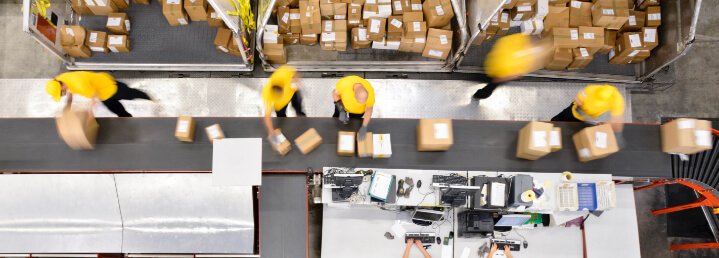
Vietnam’s ports, Cat Lai and Cai Mep in the south and Haiphong in the north, connect to the US west coast in around three weeks, the US east coast in four to five, and Europe in four to five. Logistics inside Vietnam are less developed than China’s: getting a container from factory to port can take longer, ports can be congested, and a delay of several days at the port is not unusual in peak season. Build that into the schedule rather than discovering it.
Vietnamese Apparel Manufacturing Guide: Step by Step
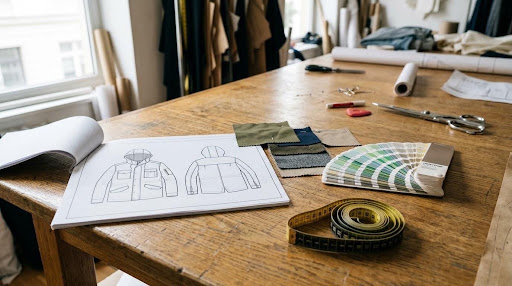
Prepare a tech pack. A Vietnamese factory quotes from a tech pack: sketches, measurements, materials, trims, construction, and labelling. Without one you will get a quote for the factory’s interpretation of your product, which is not the same thing.
Order samples. Never place a production order without a physical sample approved by you. Sample rounds in Vietnam typically take two to four weeks each, and two rounds are normal.
Confirm MOQ requirements per style and per colour before sampling, so that the sample you approve is one the factory will actually produce at your quantity.
Check restricted substances. Formaldehyde, lead, cadmium, azo dyes, mercury, and phthalates are restricted in clothing sold in the US and EU. Confirm that the factory and its fabric suppliers hold the relevant certifications, OEKO-TEX, REACH compliance, and for children’s wear CPSIA, before ordering, and specify the standards in the contract.
Lab test before bulk. Quality is what distinguishes your product, and the only way to know it is to test it. Have a pre-production sample lab-tested for fibre content, colourfastness, shrinkage, and restricted substances before the bulk order is confirmed, and inspect production before it ships.
Finding Vietnamese Apparel Manufacturing Partners
Vietnamese apparel manufacturing clusters in two regions: the south around Ho Chi Minh City, Binh Duong, and Dong Nai, which holds the largest share of the industry, and the north around Hanoi, Haiphong, and the Red River Delta. The Vietnam Textile and Apparel Association (VITAS) publishes member directories, the Saigon Tex and VIATT trade fairs bring most of the industry together each year, and the better factories hold WRAP, BSCI, or SMETA social-compliance certification and buyer-specific approvals from the brands they already serve. Verify any factory’s certifications directly with the issuing body, visit before committing, and be aware that many “factories” listed online are trading companies.
That verification, and the sampling, testing, and production management that follow, are what a sourcing partner is for. Intrepid Sourcing produces clothing in both China and Vietnam, and choosing between them, or splitting a product between the two, is part of the work we do through our clothing manufacturing service.