
Your supplier does not need to close for Chinese New Year to miss your shipping deadline. Production can slow weeks before the holiday. Materials arrive late. Workers leave. Finished goods wait for a truck or an available sailing.
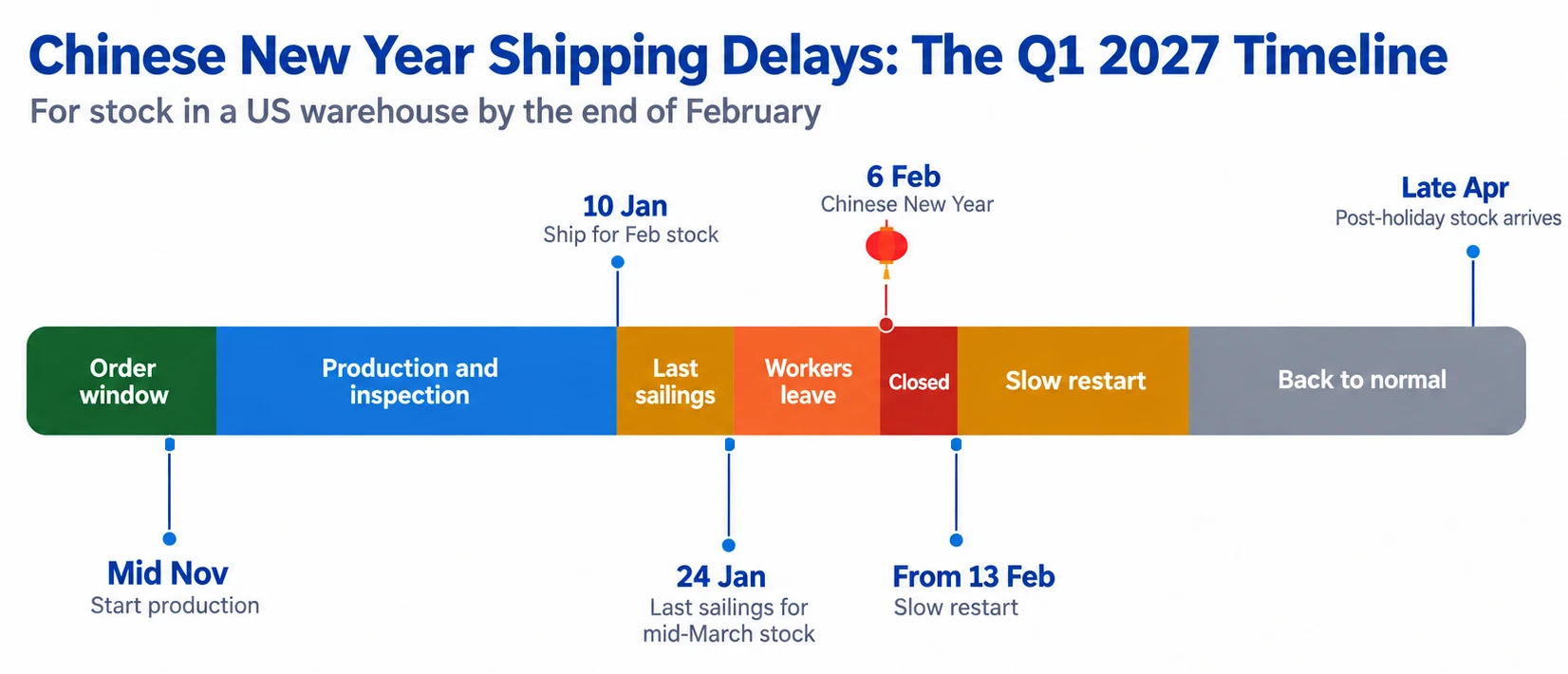
Chinese New Year shipping delays start before February 6, 2027. If you need stock in a US warehouse by late February, a practical planning target is to start production by mid-November 2026.
That leaves little room for unfinished samples or changes to your order. Your production schedule, inspection date and freight booking need to work together. Start with the date you need sellable stock, then work backward.
When Is Chinese New Year 2027?
Chinese New Year falls on Saturday, February 6, 2027. The Hong Kong Labour Department holiday calendar confirms the date.
Your factory’s closure dates are a separate question. Early to mid-February is a useful planning window, but some suppliers stop earlier or reopen later. Do not treat February 5 to 12 as a confirmed schedule for every factory.
To plan around Chinese New Year shipping delays, ask your supplier when production stops, when shipping stops and when normal output is expected to resume. These may be three different dates.
For the full explanation of worker travel, supplier closures and the extended break, read our guide to the Chinese New Year factory shutdown.
Why Chinese New Year Shipping Delays Start Early
The final weeks before the holiday are a shrinking production window.
A typical slowdown looks like this: output of about 80% two weeks before the holiday, 60% one week before and below 20% immediately before closure. These are planning estimates, not measured benchmarks for every factory.
Your supplier may still accept an order while having fewer people available to complete it. A missing component or delayed packaging delivery can then push the whole batch past the shipping cutoff.
Freight is the other source of Chinese New Year shipping delays. Brands try to move goods before the same holiday. Space tightens, while trucking and forwarding schedules may shrink.
“Finished before Chinese New Year” is therefore an incomplete commitment. You need time for inspection, any rework, packing, collection and delivery before the carrier’s cutoff.
Ask for those milestones individually. An order completed on the last working day may already be too late to leave. That gap is where most Chinese New Year shipping delays begin.
Enjoying this guide?
Practical manufacturing guidance for product brands. Factory selection, costs, quality and protecting your designs.
Order Deadlines for Q1 2027
Use the dates below to plan around Chinese New Year shipping delays with your supplier and forwarder. They are planning examples, not guaranteed delivery dates.
Your route, production lead time and warehouse location may require an earlier start.
| If you need stock… | Start production by | Ship by |
|---|---|---|
| In your US warehouse by the end of February | Mid-November 2026 | About January 10, 2027 |
| In your US warehouse by mid-March | Late November 2026 | About January 24, 2027 |
| In your US warehouse by the end of March | Confirm a pre-holiday plan or assess a faster freight option | Work backward with your forwarder |
| From production completed after the holiday | Confirm materials and capacity before the break | A March 20 departure may mean late-April arrival |
A January 24 departure is a target to confirm, not a universal last sailing. Availability depends on your port, carrier and factory’s last collection date.
Work backward from warehouse receipt through inland delivery, customs clearance, transit, origin handling and inspection. Only then set the production completion date.
For a new product launching in March or April, finish sampling, tooling and pre-production approval before late January. Treat mid-December as an approval checkpoint. If approval is still unresolved then, plan for a possible late-April or May launch.
Placing a purchase order does not mean production can start. Confirm that specifications, materials and the approved sample are ready.
What Happens After the Factories Reopen
Chinese New Year shipping delays do not end when factories reopen. A reopening date does not tell you how much your factory can produce.
Some workers return late. Others take different jobs. New staff need training, and delayed orders may already occupy the available lines. Your factory also depends on material and component suppliers restarting.
Recovery is gradual, with reduced output in the first weeks and production approaching normal around week four. Your supplier’s staffing and backlog will determine your actual schedule.
Confirm that your order has a production slot. Ask whether materials are on site and who will supervise the line.
Allow time for inspection and corrections before booking against a firm departure. Our quality assurance service can support checks as production resumes. We will cover quality risks after the restart in a separate article.
A Second Date to Watch: January 10, 2027
Your holiday schedule also sits alongside a trade deadline. Customs timing can add to Chinese New Year shipping delays.
The RV Industry Association reports that the US-China trade truce was extended through January 10, 2027. Goods arriving after that date could face different duty rules, depending on subsequent decisions and the measures covering your products.
Do not confuse a departure date with a customs deadline. Shipping from China on January 10 does not mean your goods enter the United States that day.
Ask your customs broker which rules and entry dates apply to your shipment. Confirm the position before committing to a schedule. Trade announcements can change, and separate exclusions may have different deadlines.
How to Avoid Chinese New Year Shipping Delays
Turn your holiday plan into specific commitments:
- Get dates in writing. Confirm each supplier’s production stop, final collection date and expected restart.
- Place pre-holiday orders now. Confirm available capacity and material readiness before relying on a completion date.
- Book freight early. Ask your forwarder about space, documentation deadlines and collection cutoffs.
- Consider splitting the order. Ship essential stock before the break and the balance afterward. Check the effect on freight and order quantity trade-offs.
- Plan buffer stock. Base it on expected sales and your replenishment gap. Our guide to handling demand spikes explains the inventory choices.
- Secure materials early. Confirm that fabric, components and packaging will be available.
- Give new launches room. Avoid making a launch depend on an unconfirmed pre-holiday departure.
Agree on a communication schedule too. Holiday silence can be expected, and it can hide Chinese New Year shipping delays until it is too late to react. Our guide to why suppliers stop replying helps you assess slow responses.
Final Thoughts
Chinese New Year is predictable. Your order needs a schedule that accounts for it.
To reduce Chinese New Year shipping delays, confirm production capacity now, allow time for inspection and book freight against a realistic completion date. For late-February warehouse stock, use mid-November as your production planning target.
Tell us what you’re making and when you need it. We’ll help you assess whether your Q1 timeline is realistic.