On this page
CMT vs FPP clothing manufacturing comes down to one question: who buys the materials? In CMT (cut, make, trim), you supply the fabric and trims and the factory sews. In FPP (full package production), the factory sources the materials and delivers finished garments.
Our cut and sew guide gives a short comparison of the two. This guide goes further. It covers how the costs are built, where the risks sit, a US customs point for CMT, and how to choose.
CMT vs FPP Clothing Manufacturing at a Glance
| Point | CMT | FPP |
|---|---|---|
| Who buys fabric and trims | You | The factory |
| What the factory quotes | Labor, overhead and margin | A finished garment price |
| Suppliers you manage | Factory, mills and trim suppliers | Usually one factory |
| Cash tied up early | Higher, as you pay mills before sewing | Lower, paid in line with the factory’s terms |
| Cost visibility | Full, line by line | Depends on the factory’s breakdown |
| Responsibility for defects | Split between you and the factory | Mostly with the factory |
How the Costs Differ
In CMT vs FPP clothing manufacturing, the two quotes look very different. Compare total landed cost, not the factory price.
A CMT price covers cutting, sewing, finishing and packing. You pay separately for fabric, trims, labels and packaging. You also pay to ship materials to the factory and to buy extra fabric for wastage and cutting loss.
An FPP price includes all of that in one figure per piece. The factory adds a margin for buying and managing the materials. In return, it handles mill orders, delivery and stock.
For example, take a simple shirt with these hypothetical round figures:
- CMT route. A sewing price of 4, plus fabric at 5, trims at 1, inbound freight at 0.50 and wastage at 0.50. Total: 11 per piece.
- FPP route. One price of 12 per piece, with materials included.
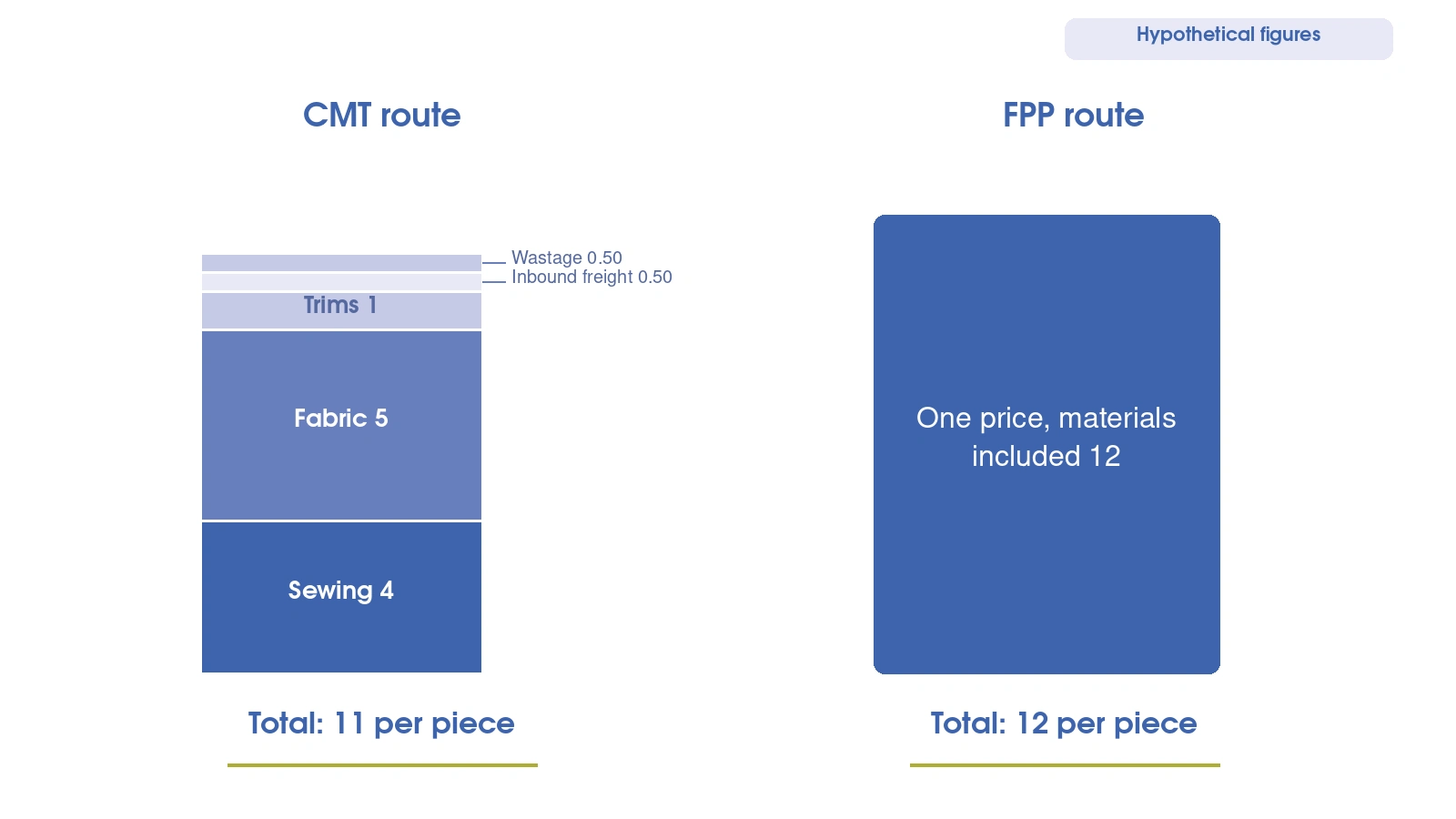
CMT looks cheaper here. But the gap can shrink once you count your team’s time, fabric minimums and leftover stock. Mill minimums apply under both models. Under CMT, you deal with them directly. Our guide on minimum order quantities explains how they push up unit costs.
Risk and Control in CMT vs FPP Clothing Manufacturing
CMT: more control, more exposure
CMT gives you full control over fabric choice, price and quality. You can also move production to another factory and take your materials with you.
The risks come from coordination. If fabric arrives late, the sewing slot can be lost. If there is a shortfall, production can stop. Defects can turn into disputes over whether the fault was in the fabric or the sewing. Agree on fabric consumption per garment in writing, and inspect fabric when it reaches the factory.
FPP: one point of responsibility
Under FPP, one supplier takes responsibility for materials, scheduling and finished quality. That suits small teams and first collections. It also gives the factory more room to substitute materials or hide cost changes. Lock down fabric, weight, composition and trims in the tech pack, and approve a pre-production sample before bulk.
Switching factories is harder under FPP. The factory holds the mill relationships and often the material stock.
A US Customs Point for CMT
US rules treat materials supplied by the buyer free or at reduced cost as an assist under 19 CFR 152.102. Under 19 CFR 152.103, the value of an assist is added to the price paid when transaction value is worked out.
Fabric you supply to an overseas factory still counts toward the customs value.
The factory invoice for CMT goods usually shows only the sewing charge. Your customs broker needs the value of the fabric and trims you supplied, so duty is paid on the full value. It is easy to miss in CMT vs FPP clothing manufacturing comparisons.
Choosing CMT vs FPP Clothing Manufacturing
The right model depends on your team, your fabrics and your order volumes.
CMT tends to fit brands that
- Have staff who can source fabric and manage mills.
- Use special or proprietary fabrics.
- Order in volumes large enough to meet mill minimums.
- Want open, line-by-line costing.
FPP tends to fit brands that
- Have a small team or are launching a first collection.
- Want one supplier accountable for the finished product.
- Prefer to tie up less cash before production.
There is also a middle route in CMT vs FPP clothing manufacturing. The brand nominates the mill and fabric, and the factory buys it. You keep control over the material while the factory handles ordering and stock.
Before you decide, ask each factory the right questions about sourcing, sampling and inspection.
Final Thoughts
The CMT vs FPP clothing manufacturing choice is a trade between control and simplicity. CMT gives you cost visibility and material control but more coordination risk. FPP gives you one accountable supplier but less visibility. Compare total landed cost, not the headline price, and include assists when calculating your customs value.
Our clothing manufacturing service covers tech packs, samples, production oversight and inspection of each bulk batch.