The electrical engineering and electronic equipment industry produces and installs the systems that nearly every other sector depends on: power distribution, industrial control, communications infrastructure, and the components inside consumer and commercial products. It went through a genuine disruption between 2020 and 2022, and the useful question now is not what happened but what permanently changed.
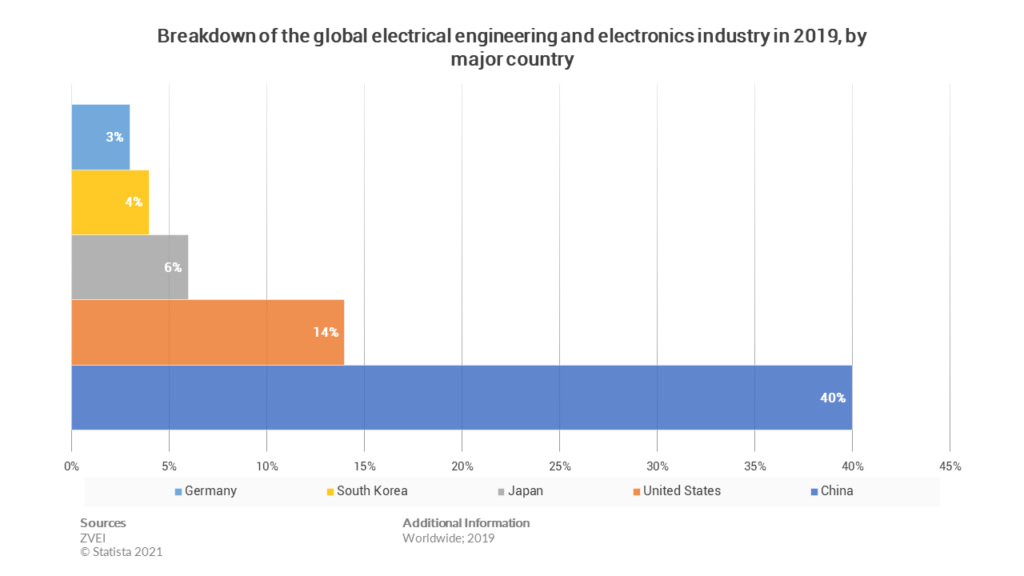
Where the Electrical Engineering and Electronic Equipment Industry Sits by Country
China is the largest producer by a wide margin, and its position has strengthened rather than weakened since 2020. Chinese integrated circuit exports passed US$200 billion in 2025, up 26.8%, and the country dominates PCB fabrication, passive components, connectors, and assembly.
The rest of the picture is specialised rather than general. Taiwan and South Korea hold leading-edge semiconductor fabrication. Japan and Germany lead in industrial automation, precision equipment, and machine tools. The United States leads in chip design and equipment. Each of these is a genuine dependency for the others, which is what makes the industry vulnerable to export controls in a way it was not a decade ago.
What Actually Changed in the Electrical Engineering and Electronic Equipment Industry
The disruption of 2020 to 2022 is often described as a pandemic effect. Some of it was, and that part has passed. What has not passed is the structural change underneath.
Supply chains got shorter and more duplicated. The semiconductor shortage taught manufacturers that single-sourcing a component is a business risk rather than an efficiency, and dual-sourcing and larger buffer stocks are now normal in the electrical engineering and electronic equipment industry.
Geography became a policy question. Export controls on advanced chips and equipment, tariffs on Chinese goods, and China’s own controls on gallium, germanium, and rare earths have made where a component comes from a strategic decision, not just a commercial one.
Demand shifted to infrastructure. AI data centre construction has pulled semiconductor and power-equipment demand up sharply since 2024, and that demand competes with consumer products for the same capacity, which lengthens lead times and firms prices for ordinary components.
What This Means for a Product Company
Three practical consequences follow for anyone buying from the electrical engineering and electronic equipment industry.
Design for component availability. Specify parts with long lifecycle commitments, qualify a second source where the design allows, and treat a single-sourced part as a schedule risk rather than a cost saving.
Order long-lead items first. A chip on allocation holds up an entire product, and allocation is unpredictable enough that ordering early costs less than it appears to.
Watch counterfeits. When components are scarce, relabelled and recovered parts enter the supply chain. Buying through authorised distributors, or a supplier that does, is the main protection. The electronic components industry report covers this in more detail.
Wrapping Up
The electrical engineering and electronic equipment industry recovered from its disruption and came out of it structurally different: more duplicated, more politically constrained, and with capacity increasingly drawn toward infrastructure rather than consumer goods. For a product company that means planning around component availability rather than assuming it, and treating supply chain structure as a design input. Managing that for an electronics product is what our electronics production package covers.