Introduction
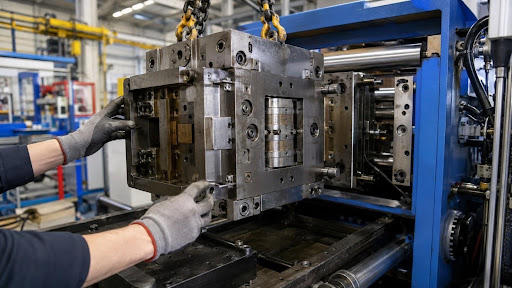
A tooling charge pays for the steel mold, jigs and fixtures built specifically for your product. Paying that invoice does not automatically make the tooling yours, and that single gap causes more supplier disputes than unit price ever does.
What a Tooling Quote Actually Covers?
A standard tooling quote includes the mold base, cavity machining, CNC work and the first trial shots needed to bring samples to specification. It usually stops there.
Costs that sit outside most quotes:
- Design changes requested after tool approval
- Additional cavities added to raise output later
- Spare inserts and replacement components
- Long-term maintenance and refurbishment
- Storage once the tool sits idle between orders
Cavity count deserves attention at quoting stage. A four-cavity tool costs more upfront than a single-cavity tool but cuts cycle time and unit price at volume, so the decision belongs in your cost model rather than in the supplier’s.
The Three Ownership Models
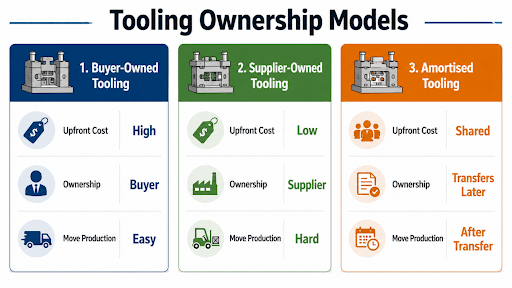
The right tooling ownership model depends on your budget, production volume and need for long-term control. Each option changes who carries the upfront cost and how easily production can be moved later.
Buyer-Owned Tooling
You pay the full tooling cost and the mold becomes your asset. This is the highest upfront spend and the only model that lets you move production without rebuilding anything. Insist on it when the product is your core line.
Supplier-Owned Tooling
The supplier absorbs the tooling cost and recovers it through the unit price. Upfront cost drops to near zero, but leaving means starting tooling again elsewhere. Useful for testing a product, risky for a product that succeeds.
Amortised Tooling
The tooling cost is spread across an agreed order volume, with ownership transferring once that volume is reached. The model works well as long as the transfer trigger is written down. Verbal understanding of the threshold is where these arrangements fail.
Five Points to Put in the Agreement
These terms should clearly define ownership, maintenance responsibilities, and the conditions for accessing or transferring the tooling. Setting them out before production begins helps prevent disputes later.
A statement naming your company as owner of all molds, jigs, fixtures and CAD files
- Cavity count, steel grade and expected shot life of the tool
- Who maintains the tool, how often, and at whose cost
- Storage terms and the conditions under which the tool is released
- A written right to collect or transfer the tooling within a stated number of days
Each point is ordinary to include before production starts and difficult to add once a relationship has soured.
Before You Pay the Tooling Invoice
Ask for tool drawings and steel certificates, and confirm the tool is physically tagged with your company name. Photograph it at the factory once it is built.
Then agree in writing what happens to the tooling if the supplier relationship ends, the factory changes ownership, or production moves to a second site for capacity reasons.
Why This Matters More Than the Tooling Cost?
Moving production is a normal part of scaling. Suppliers reach capacity limits quality expectations rise and tariffs shift the maths on where a product should be made.
Rebuilding tooling because ownership was never documented adds cost and weeks of delay at exactly the moment a brand can least afford either. Establishing ownership on day one keeps that door open at no extra cost.
Final Thoughts
Ask the question before the steel is cut, not after the first reorder. A supplier who answers it clearly is usually the one worth staying with.
Intrepid Sourcing builds tooling that stays your property from the first shot. Tell us what you are making and we will scope it with you.