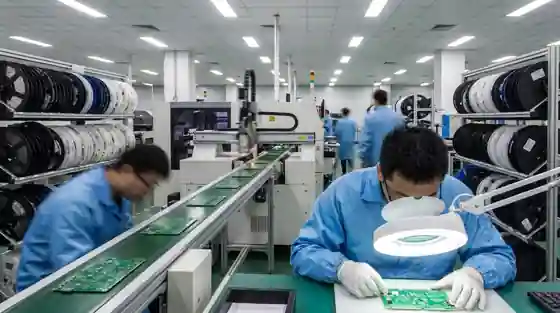

Electronics manufacturing services, EMS, means outsourcing the design, assembly, testing, and sometimes distribution of an electronic product to a specialist provider. Almost no consumer electronics brand builds its own factory now, and the EMS industry is what makes that possible for companies of every size.

What Electronics Manufacturing Services Cover
The scope runs wider than assembly. A full-service provider handles design support and design for manufacturability, component sourcing and bill-of-materials management, PCB assembly, mechanical assembly and enclosure fitting, functional testing, certification support, and packaging and fulfilment.
Some brands use all of it, treating the provider as their manufacturing arm. Others use assembly only, keeping design and sourcing in-house. The choice depends mostly on internal engineering capability.
High-Mix, Low-Volume Is the Real Change
The most consequential shift in electronics manufacturing services for smaller brands is the growth of high-mix, low-volume capability: providers set up to run many different products at modest quantities rather than one product at millions.
That model is what has made hardware accessible to companies that could never have interested a large contract manufacturer. Flexible lines, faster changeovers, and automated optical inspection make short runs economic in a way they were not a decade ago.
What Electronics Manufacturing Services Cost and Require
Minimum quantities typically run 1,000 to 5,000 units for a custom product, driven by component minimums and line setup rather than by the assembly itself. Some providers go lower on a first order.
Certification is the item most often missing from a first budget. A connected device needs FCC for the US and CE with radio equipment conformity for the EU; lithium batteries need UN38.3 and IEC 62133; mains products need UL or ETL. Ask whether the provider supports certification or expects you to arrange it.
Component risk is now a live issue. Single-sourced parts are a schedule risk, and counterfeit or remarked components enter the supply chain whenever parts are scarce. A provider buying through authorised distributors is worth paying for.
Where Electronics Manufacturing Services Sit
The industry is concentrated in Asia, particularly around Shenzhen, where component distributors, PCB fabricators, display and battery suppliers, and assemblers sit within hours of each other. That density is why prototype-to-production timelines are shorter there than anywhere else, and it is the practical reason most hardware products are made in the region. The electronic components industry report covers that supply chain.
Vietnam, Mexico, and India have taken a growing share since 2018 as brands diversified against tariffs, mostly in final assembly rather than component supply.
Choosing a Provider
Establish what comparable products they have built, whether they hold current ISO 9001 and the product certifications they claim, what their real minimums are, whether they do their own testing and to what standard, and how they handle component sourcing and obsolescence. Verify certificates with the issuing body rather than accepting a scan.
Developing an electronic product from design through certification to production, with providers that have built comparable devices, is what our electronics production package covers.