
The men’s clothing market covers all clothing for men and boys, excluding babywear, and it is roughly half the size of the womenswear market. Its segments are coats and outdoor jackets, jackets, blazers and suits, trousers, shirts, knitwear, and men’s underwear. Women hold the larger share of apparel spending overall, but the men’s clothing market has grown faster than womenswear across several segments, including luxury, for most of the past decade, and menswear is where several established womenswear labels have expanded to find growth.
Where the Men’s Clothing Market Stands
The global apparel retail market was worth around US$1.9 trillion in 2025 and is forecast to reach US$2.3 trillion by 2030, growing at roughly 4% a year. Within it, the men’s clothing market has grown steadily, and the largest national markets are China and the United States, followed by Japan, Germany, the United Kingdom, and India. China overtook the United States as the largest men’s clothing market during the 2020s and continues to grow faster, driven by rising incomes, urbanisation, and a young male consumer far more engaged with fashion than the previous generation.
The rest of the top ten is stable: the mature Western European markets, Japan, and, increasingly, India, which has the fastest growth rate of any large market from a low base per capita.
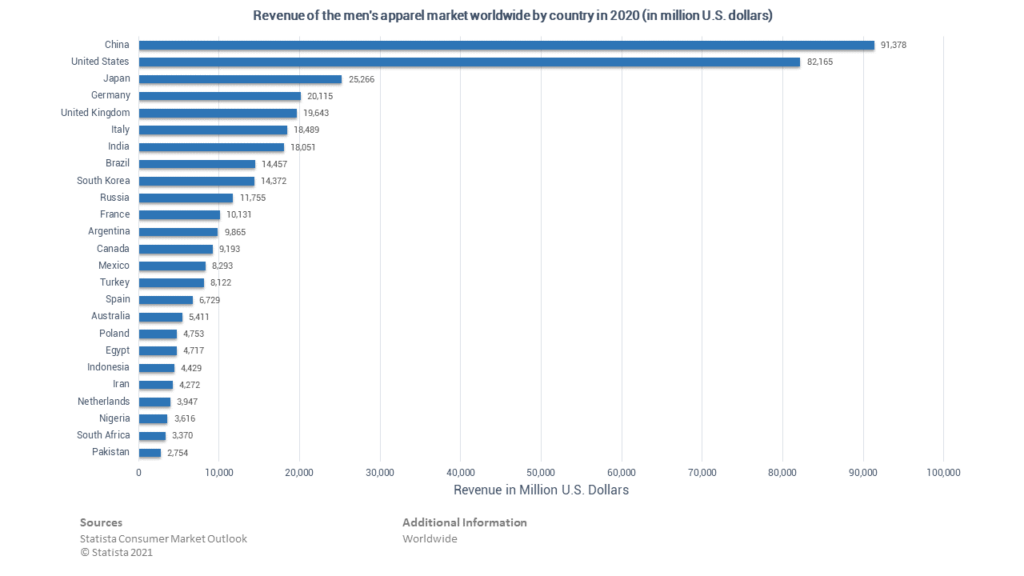
Men’s clothing market revenue by country. China and the United States together account for a large share of the global total.
What Is Driving the Men’s Clothing Market
Three things have changed the men’s clothing market since 2020, and all three outlasted the circumstances that produced them.
Online is the default channel. Men were slower than women to buy clothing online and are now at least as comfortable with it; convenience and range are the reasons usually given. Fashion e-commerce has grown across every market, and for menswear specifically the online share is now higher than for womenswear in several countries, because men shop less often and browse less, which suits a channel built on search and repeat purchase.
Casualisation is permanent. Tailoring and formalwear lost share when offices emptied and have not fully recovered, while knitwear, casual trousers, outerwear, and activewear have taken their place. The suit has become an occasion purchase rather than a workwear one in most Western markets, which has reshaped what the men’s clothing market sells.
Premium menswear grew faster than mass. Men who buy less buy better, and the premium and luxury segments have grown faster than the middle of the men’s clothing market for several years. That has drawn womenswear-led brands into menswear and driven growth in categories, footwear, outerwear, accessories, where a higher price is easier to justify.
What This Means for a Brand
The men’s clothing market rewards a narrower proposition than womenswear does. Men buy less frequently, research more before buying, and repurchase what worked, which favours brands built on fit, fabric, and consistency rather than on seasonal newness. It also means a small range done well can support a brand, where a womenswear brand would need constant new collections.
Practically, that points to a core range of well-made basics in a defined fit, produced consistently enough that a customer can reorder the same item in a year and get the same product. That consistency is a manufacturing question: it depends on the same factory, the same fabric supplier, and a specification tight enough that a reorder matches the original. Intrepid Sourcing’s clothing manufacturing service covers fabric sourcing, sampling, fit, and production across China and Vietnam, and it is built around exactly that kind of repeatability.
Conclusion
The men’s clothing market is about half the size of womenswear, growing at a similar or faster rate, and led by China and the United States. Its growth is in premium, casual, and online, and its structure, infrequent purchase, high repeat rate, favours brands that get fit and quality right and keep them right. For a new brand, that is a more achievable target than out-designing the womenswear market, and it is where the men’s clothing market has been rewarding entrants.