Asia clothing manufacturing supplies most of the world’s apparel, and four countries account for the bulk of it: China, Bangladesh, Vietnam, and India. Between them they hold well over half of global clothing exports, and most Western brands buy from at least one. Each has a genuinely different profile, and the right answer for a given product depends on what the product is and where it is going. This article covers what each country is good at and where each falls short.

China: The Core of Asia Clothing Manufacturing
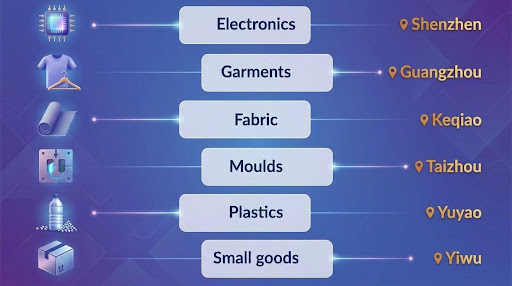
Fabric and supply chain. China’s decisive advantage in Asia clothing manufacturing is that it makes the fabric. It produces the majority of the world’s textile fibre and fabric, so a Chinese garment is made from material a few hours away, while a Vietnamese or Bangladeshi one is usually made from fabric imported from China. That means shorter lead times, far more fabric choice, and the ability to change a specification without waiting weeks for imported material.
Skill and capability. China has the deepest layer of pattern makers, production managers, and quality staff in the region, which is what makes complex garments possible: technical sportswear, structured outerwear, seamless knits, bonded seams. It has also automated heavily, installing 295,000 industrial robots in 2024, more than half the world’s total.
Speed and flexibility. Sampling in one to three weeks, production in four to eight, and a supply chain close enough together that problems get solved by driving an hour. For small and medium runs, China is the most flexible option in Asia clothing manufacturing.
Where it falls short. Cost. Manufacturing wages average around US$15,800 a year, roughly twice Vietnam’s and several times Bangladesh’s, and China’s share of world clothing exports has fallen to 29.6%, its lowest since 2010. US tariffs have pushed the effective rate on Chinese apparel to around 35%, against roughly 20% on Vietnamese goods.
Vietnam in Asia Clothing Manufacturing
Cost with capability. Vietnam sits between China and Bangladesh: cheaper labour than China, better capability than Bangladesh. It is particularly strong in knitwear, sportswear, and outerwear, and several of the world’s largest specialist manufacturers of those categories operate there. Textile and garment exports passed US$46 billion in 2025 (VITAS).
Trade agreements. Vietnam has one of the widest trade agreement networks of any manufacturing country: ASEAN membership, the EU–Vietnam FTA in force since August 2020 which eliminates most tariffs on clothing entering the EU, CPTPP, and RCEP. For EU-bound clothing, that is a substantial and often decisive advantage, subject to rules of origin that generally require the fabric to come from Vietnam or a partner country.
Where it falls short. Fabric. Vietnam imports most of its fabric, largely from China, which adds lead time and complicates rules-of-origin qualification. Minimum order quantities are high, typically around 1,000 pieces per style and colour, because the industry is built on volume. Port congestion and inland logistics are less reliable than China’s.
Bangladesh in Asia Clothing Manufacturing
The lowest cost in Asia clothing manufacturing. Bangladesh has the lowest garment labour costs of the four, which is why it is the world’s second- or third-largest clothing exporter depending on the measure, at around US$40 billion a year, and why it dominates high-volume basics: t-shirts, knitwear, denim, and simple wovens.
Safety, much improved. The Rana Plaza collapse in 2013, which killed over 1,100 workers, forced a transformation across asia clothing manufacturing. The International Accord inspected thousands of factories. Bangladesh now has more LEED-certified green garment factories than any other country. The industry’s safety record is far better than it was, though enforcement remains uneven outside the audited tier, and the country’s political instability since 2024 has disrupted production at times.
Where it falls short. Capability and fabric. Bangladesh is strongest at simple, high-volume garments and thinner on technical work, and it imports most of its fabric. Lead times are longer, and infrastructure and port capacity constrain throughput.
India in Asia Clothing Manufacturing
Materials and craft. India’s advantage is its own raw materials: it is one of the world’s largest cotton producers and has a deep textile industry from fibre through fabric, which few Asian producers other than China can claim. It is strong in cotton wovens, home textiles, embroidery, and handwork, and its craft capability in embellishment is unmatched in the region.
Scale and growth. Textile and apparel exports run around US$37 billion, and India is the destination most often named by brands diversifying away from China after Vietnam.
Where it falls short. Consistency and lead times. Indian garment production is fragmented across many small units, quality varies more than in China or Vietnam, and lead times are longer. Infrastructure and internal logistics are the recurring constraint.
Choosing Among the Asia Clothing Manufacturing Options
The practical decision in Asia clothing manufacturing comes down to product type and destination. High-volume basics for the US market usually price best in Bangladesh or Vietnam. EU-bound clothing benefits from Vietnam’s trade agreement. Cotton wovens, embroidery, and handwork suit India. Technical, structured, fabric-intensive, fast-turnaround, or small-run products still suit China, and for a first collection China’s flexibility on minimums and sampling is often worth more than a lower unit price elsewhere.
Most established brands now use more than one country, keeping technical work in China and moving basics to Vietnam or Bangladesh, which is the “China plus one” approach in practice. Working out which country suits a specific product, and managing production there, is what our clothing manufacturing service does; we produce in China and Vietnam and can advise honestly on when neither is the right answer.