
The women’s clothing market is the largest segment of the global apparel industry, ahead of menswear and children’s wear, and it has grown steadily for a decade. It covers coats and outerwear, blazers, suits, dresses, skirts, trousers, sweatshirts, and blouses, with babies’ and children’s clothes counted separately. Womenswear leads the clothing market because women buy more apparel items on average than men and replace them more often, and because the range of categories is wider.
The global apparel market is worth roughly US$1.9 trillion in 2025 (Statista) and is expected to reach around US$2.3 trillion by 2030, with womenswear the largest single share of it. Growth has come from rising female workforce participation, higher disposable income in Asia, and the acceleration of trend cycles through social media.
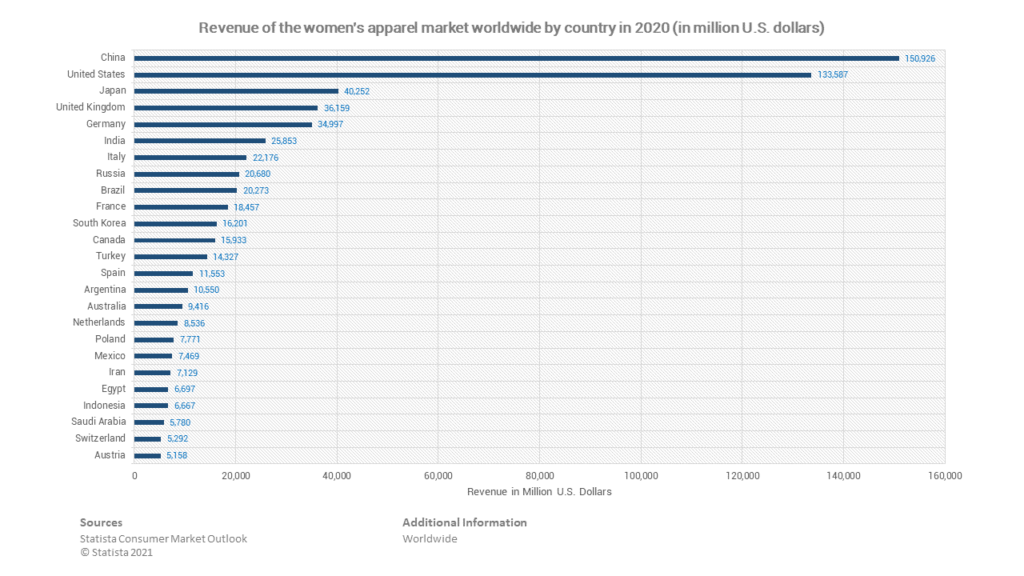
Women’s clothing market revenue by country. China and the United States together account for a large share of the global market.
What Drives the Women’s Clothing Market
Three forces sustain growth. The first is workforce participation: women make up around 39% of the global workforce (World Bank), and the proportion has risen over the past two decades, which raises both income and the number of occasions clothing is bought for. The second is the pace of trend cycles, driven by social media and influencer marketing, which shortens the useful life of a garment and increases purchase frequency. The third is category expansion: brands that once sold clothing now sell footwear, accessories, activewear, and loungewear alongside it, and the women’s clothing market has absorbed categories that barely existed a decade ago.
Working against those is a set of real constraints. Consumer demand in the United States and Europe has been soft since 2023 under inflation and higher interest rates. The 2025 US tariffs raised the landed cost of imported clothing sharply. And sustainability regulation in the EU, from extended producer responsibility to textile waste rules, is adding cost and compliance obligations across the industry.
The Largest Markets
China and the United States are the two largest national markets for women’s clothing by a wide margin, together accounting for a large share of global revenue. Japan, Germany, the United Kingdom, India, France, and Italy follow. The pattern that matters for a brand is the direction of growth rather than the current ranking: Asia-Pacific is the largest region and the fastest-growing, driven by China, India, and Southeast Asia, while the Western markets are larger per capita but growing slowly.
That has a practical consequence. The women’s clothing market is increasingly one where the fastest-growing customers and the manufacturing base are in the same region, which changes the logic of where a brand sells as well as where it produces.
The Outlook
Forecasts for the women’s clothing market converge on annual growth of 4% to 6% through the end of the decade, with online channels taking a growing share and the premium and value ends both growing faster than the middle. Fast fashion sold direct from Chinese factories, led by Shein and Temu, has compressed prices in the mass market, while the premium segment has held up on brand and quality. Activewear and loungewear continue to take share from formal categories, a shift that began before 2020 and did not reverse afterwards.
For a brand, the women’s clothing market is large, growing, and more open to new entrants than it has been in decades, because online channels removed the retail gatekeepers. What decides whether a brand captures any of it is product: fit, fabric, and the ability to get a collection made well and on time. That depends on the factory, and matching a product to a factory that has made something like it before is what our clothing manufacturing service does, across China and Vietnam.