Global clothing market revenue reached an estimated US$736.6 billion in 2025 and is projected to pass US$783 billion in 2026, growing at around 6.3% a year (The Business Research Company, 2026). On the broader measure that includes all apparel retail, the global market was worth around US$1.9 trillion in 2025 and is expected to reach US$2.3 trillion by 2030. Whichever scope you use, clothing market revenue has fully recovered from the 2020 collapse and is growing again, but growth has shifted decisively toward Asia and toward online channels, and that shift is what matters for anyone deciding where to sell clothing and where to make it.
Clothing Market Revenue After 2020
In 2020, clothing market revenue fell sharply as retail closures and stay-at-home orders across most of the world cut apparel spending faster than any category except travel. Supply chains were disrupted on both ends: factories in Asia closed for weeks, then Western retailers cancelled orders already in production. The market recovered faster than most forecasts expected, with clothing market revenue passing its 2019 level by 2022, but the recovery was uneven. Online sales took a permanent step up, activewear and casual categories grew while formalwear did not fully recover, and the geographic balance of the market moved toward Asia-Pacific.
The Global Clothing Market Revenue by Region
Asia-Pacific is the largest region for clothing market revenue, with over a third of the global market, and it is also the fastest-growing, driven by China, India, and Southeast Asia. Western Europe is second at roughly a quarter of global revenue, and North America third at around a fifth. The largest single national markets are the United States and China, which together account for more than 40% of clothing market revenue worldwide, followed by Japan, Germany, the United Kingdom, India, France, and Italy.
Two things about that regional picture matter for a brand. The Asian markets are growing faster than the Western ones, which means the customers of the next decade are increasingly there. And Asia is also where clothing is made: China holds around 30% of world clothing exports, with Vietnam, Bangladesh, India, and Cambodia behind it, so the manufacturing base and the fastest-growing demand now sit in the same region.
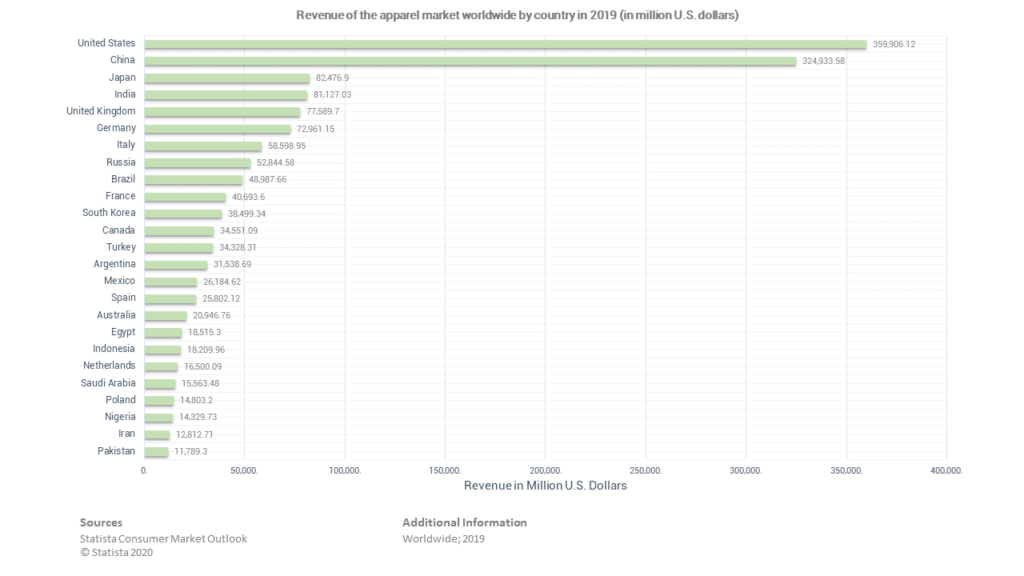
Clothing market revenue by country. The United States and China together account for more than 40% of the global market.
The Global Clothing Market Revenue Forecast
Forecasts for clothing market revenue vary by scope and source, but they agree on direction and on drivers. The Business Research Company projects growth of around 6% a year to 2030 on its production-based measure; retail-based forecasts put annual growth at 4% to 5%. The drivers are rising disposable income in Asia, the continued shift of sales online, and the growth of categories, activewear, athleisure, and casualwear, that consumers now buy more often and wear more widely than the formal categories they replaced.
The constraints are equally clear. Consumer demand in the United States and Europe has been soft since 2023 under inflation and higher interest rates, and the 2025 US tariffs raised the landed cost of imported clothing sharply. Sustainability regulation, from the EU’s extended producer responsibility rules to restrictions on textile waste, is adding cost and compliance requirements across the industry. And fast fashion’s growth, led by Shein and Temu selling direct from Chinese factories to Western consumers, is compressing prices in the mass market while the premium end grows.
Clothing Market Revenue by Segment
Three breakdowns are worth knowing, because they decide where a new brand competes.
By fabric. Cotton remains the largest single fibre in clothing by value, with polyester the largest by volume and growing faster. Blends dominate in practice. Recycled polyester and certified organic cotton have moved from premium to expected, and in the EU are heading toward regulatory requirement rather than preference.
By usage. Womenswear is the largest segment, at roughly twice menswear. Childrenswear is smaller and more resilient, because replacement is driven by children growing rather than by fashion. Within all three, casual and performance clothing have taken lasting share from formalwear.
By distribution channel. Online has taken a substantial share of clothing market revenue and settled well above pre-2020 levels rather than falling back. Direct-to-consumer brands have been the main beneficiaries, since the model removes the retail margin and returns the customer relationship to the brand.
What Drives Clothing Market Revenue Growth
The durable drivers are population and income growth in Asia-Pacific, which is both the fastest-growing consumer market and the main producer; the shift to online buying, which lowered the barrier for new brands; and the comfort-led shift in what people wear, which has permanently reallocated revenue from formal to casual and performance categories.
Working against those: tariffs have become the largest single variable in landed cost for US importers, and compliance obligations in the EU now reach back through the supply chain, both of which raise the real cost of serving those markets.
The Future of the Clothing Market
Three trends will shape clothing market revenue over the next decade. Manufacturing will keep automating: computer-controlled cutting, automated sewing for simple constructions, and digital printing are reducing labour content and, with it, the cost advantage of the lowest-wage countries. Sourcing will keep diversifying: the “China plus one” strategy that moves final assembly to Vietnam, Bangladesh, or India while fabric still comes from China is now standard among large brands. And the online share of clothing market revenue will keep rising, with social commerce and live-streaming, already dominant in China, spreading to Western markets.
For a brand, the practical reading is that the clothing market is large, growing, and more open to new entrants than it has been in decades, because online channels have removed the retail gatekeepers, but that the cost and compliance side has become harder. Getting a product made well, at the right cost, in the right country for the markets you sell to, is the part that decides whether a brand’s share of clothing market revenue grows. That is what Intrepid Sourcing’s clothing manufacturing service does, across factories in China and Vietnam.