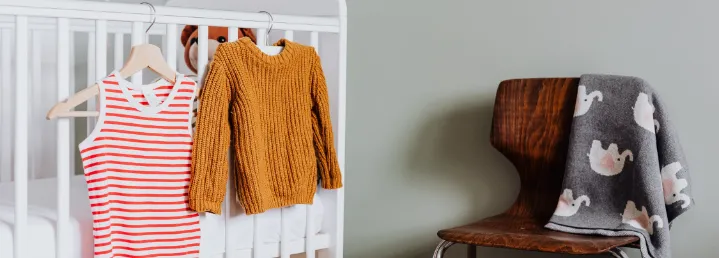
Deciding to make your own baby clothes starts with a simple fact: clothing a growing child is expensive, and a newborn will outgrow several sizes before their second birthday. Making them yourself is one answer, and it has advantages beyond cost: you control the fabric against your baby’s skin, you can make exactly the sizes and styles you want, and simple baby garments are among the easiest things to sew. This guide covers how to make your own baby clothes, and what to know about safety, which matters more for infant clothing than for anything else you might sew.
Make Your Own Baby Clothes Safely: Read This First
This section is missing from most guides on how to make your own baby clothes and should not be. Infant clothing is regulated because babies are vulnerable to hazards that adults are not, and the same principles apply whether a garment is made in a factory or at a kitchen table.
- No small detachable parts. Buttons, snaps, beads, and appliqués are choking hazards. Anything attached must be attached securely, and for babies under one, avoid decorative attachments entirely where you can.
- No drawstrings or long ties at the neck or hood. Drawstrings in children’s neckwear are banned in the US and restricted in the EU because of strangulation risk.
- No loose ribbons or long loops. Anything that can wrap around a neck or catch on furniture is a hazard.
- Sleepwear should be snug-fitting or made from flame-resistant fabric. Loose, flowing nightwear in a flammable fabric is the specific hazard that sleepwear regulations exist to address.
- Wash before wearing. New fabric carries processing chemicals and dyes; wash in a fragrance-free detergent before the garment touches skin.
Guidelines to Make Your Own Baby Clothes
1. Make Your Own Baby Clothes: Choose the Fabric
Fabric matters more than construction for baby clothes. Choose soft, lightweight, breathable natural fibres: cotton jersey, cotton interlock, muslin, and bamboo-derived viscose are the usual choices, and organic cotton is worth the premium for anything worn against newborn skin. Look for fabric that washes well without shrinking or fading, since baby clothes are washed constantly. Prewash and dry the fabric before cutting, because cotton jersey shrinks, and a garment cut from unwashed fabric will not fit after its first wash. Avoid scratchy fabrics, stiff synthetics, and anything with a rough surface finish.
2. Make Your Own Baby Clothes: Choose a Pattern
Start with a commercial pattern in the size you need rather than drafting from scratch: baby patterns are inexpensive, widely available in print and as free downloads, and already account for the ease and neck openings a baby garment needs. If you prefer to draft your own, the simplest method is to trace an existing garment that fits: lay it flat, trace around it onto paper, add a seam allowance of about 1 centimetre, and mark the fold lines.
3. Take Measurements
Measure chest, waist, back length from neck to hem, and, for sleeves, shoulder to wrist. Babies grow fast, so add ease: a garment that fits exactly today fits for a fortnight. Two to three centimetres of ease at the chest is a reasonable starting point, and making the next size up is often the better decision.
4. Cut
Lay the fabric flat, on the fold where the pattern requires it, and pin the pattern down before cutting. Cut with sharp fabric scissors or a rotary cutter, and cut all pieces before you start sewing. Transfer any pattern markings, notches and fold lines, to the fabric.
5. Make Your Own Baby Clothes: Sewing
Sew with a stretch stitch or a narrow zigzag if you are working with jersey, because a straight stitch will snap when the fabric stretches. A serger or overlocker gives a neater and more durable finish but is not essential. Press seams as you go. Keep seams flat and smooth on the inside: a bulky or scratchy interior seam is the most common reason a homemade baby garment is uncomfortable, and flat-felled or serged seams are worth the extra effort. Consider putting seams on the outside for newborn garments, which some commercial brands now do.
6. Fit and Modify
Try the garment on the baby before finishing the hems, and adjust length and neck opening as needed. The neck opening is the detail most often wrong on homemade baby clothes: it needs to stretch enough to pass over the head easily, which usually means more than it looks like it should. Envelope shoulders, the overlapping design on commercial bodysuits, exist for exactly this reason and are worth copying.
7. Finishing Homemade Baby Clothes
Use snaps rather than buttons where you can; they are more secure and faster for nappy changes. If you use elastic, encase it rather than sewing it directly against the skin. Keep decoration minimal and securely attached. Label the garment with fabric content and washing instructions if you are giving it away.
Make Your Own Baby Clothes: What to Sew First
When you make your own baby clothes, start with simple items: a knotted gown, a kimono-style wrap top, elastic-waist trousers, a bib, or a simple romper. Bodysuits with envelope necks and snap closures are a step up, and structured items like jackets or anything with a zip come later. Baby clothes are small, which makes them cheap in fabric and quick to finish, and that makes them a good place to learn.
When You Should Not Make Your Own Baby Clothes
Choosing to make your own baby clothes works well for a family. It does not scale, and anyone thinking of turning it into a business faces a different problem: baby and children’s clothing is the most heavily regulated apparel category there is. Products sold in the United States require CPSIA compliance with third-party testing and permanent tracking labels; the EU requires EN 14682 compliance on cords and drawstrings, plus REACH restrictions on chemicals; and flammability standards apply to sleepwear in both markets. Those requirements apply to a small brand exactly as they apply to a large one.
For anyone moving from making baby clothes at home to selling them, that compliance work, and finding a factory that can produce to it, is what our children’s clothing manufacturing service handles, with the testing covered under our quality assurance work.