
Activewear is clothing designed for exercise and sport: stretch fabrics, moisture management, and construction that moves with the body. The women’s activewear market has grown from a sub-segment of sportswear into one of the largest categories in apparel, and it keeps growing faster than clothing as a whole.
The women’s segment accounted for 47.9% of global activewear revenue in 2025, in a market worth US$440 billion and growing around 9% a year (Grand View Research, 2026); estimates for the women’s activewear market alone range from about US$92 billion to US$212 billion for 2025 depending on how broadly the category is defined, and every forecast has it growing at 5% to 8% a year through the early 2030s. The boom that started in 2020 did not fade; it became the baseline.
The Key Drivers of Women’s Activewear Market Growth
Fabric technology is the first driver. Synthetic stretch fabrics, polyester and nylon blended with elastane, have become more flexible, more durable, and better at managing moisture than anything natural fibres can do, and each improvement lets designers make activewear that is lighter, better-fitting, and more comfortable. Recycled polyester and nylon now let brands make the same fabrics with a sustainability claim, which retailers increasingly require.
Marketing is the second. The women’s activewear market grew up alongside social media, and brand collaborations with athletes, trainers, and influencers are how most activewear is sold. A brand can build a following on fit and a distinctive look without a retail presence at all, and most of the category’s fastest-growing names, Gymshark, Alo, Vuori, and Skims among them, did exactly that.
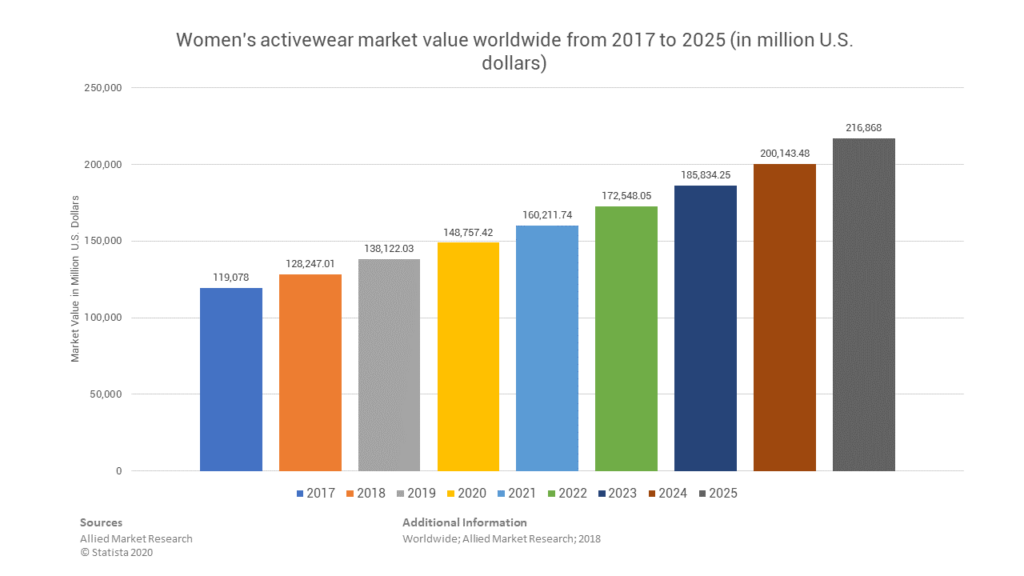
The women’s activewear market has grown every year since 2020 and forecasts have it growing to the 2030s.
The Growing Influence of Sports and Healthy Lifestyle Trends
Health awareness is the underlying driver of the women’s activewear market. Rising rates of lifestyle-related disease, cardiovascular conditions and diabetes among them, and a broader shift toward fitness as part of daily life have pushed more women into regular exercise, and every new gym membership, running habit, and yoga class is demand for activewear. Fitness participation among women has risen faster than among men in most developed markets over the past decade, and the number of health and fitness clubs worldwide grew around 4% in 2025.
Athleisure extends that demand beyond exercise. Leggings, sports bras, and joggers are now everyday clothing for a large share of women, worn to work, to travel, and at home, and that has multiplied the occasions on which activewear is bought. The women’s activewear market is no longer sized by how many women exercise; it is sized by how many women wear comfortable clothing, which is nearly all of them.
A Demographically Growing Market
The women’s activewear market grows in every age group. Younger women, Gen Z and millennials, are the largest buyers and the most trend-driven, and they set the category’s style direction. Women over 40 are the fastest-growing segment, as fitness participation among older adults rises and brands extend their sizing and fit ranges. Inclusive sizing has gone from a differentiator to a baseline requirement: a women’s activewear brand that does not offer an extended size range is leaving a large share of the market to competitors that do.
Geographically, North America is the largest region, with 35% to 47% of the women’s activewear market depending on the estimate, followed by Europe; Asia-Pacific is the fastest-growing, driven by China and India, where fitness participation is rising from a low base. For a brand, that means the established markets are where the margin is and the Asian markets are where the growth will come from.
Women’s Activewear Market Value and Forecast
Forecasts for the women’s activewear market to 2030 and beyond agree on direction: growth of 5% to 8% a year, with the premium segment growing faster than the mass market and online channels growing faster than stores. Leggings and tights are the largest product type, at around 27% of sales, and sports bras are the fastest-growing (Mordor Intelligence, 2026).
Sustainable and organic materials are the fastest-growing material category, from a small base. The constraints on the forecast are fabric costs, which move with oil, and the regulatory pressure on synthetic textiles in the EU over microplastics and end-of-life, which is pushing brands toward recycled and recyclable fabrics.
For a brand entering the women’s activewear market, the forecast is favourable and the competition is intense. The category rewards fit, fabric, and speed, and all three depend on the factory: a sports bra or a pair of leggings needs pattern-making, grading, and fabric sourcing that a general garment factory will get wrong. Intrepid Sourcing’s sportswear manufacturing service places activewear with factories that specialise in it, in China and Vietnam, and manages fabric, sampling, fit, and production so that a first collection ships fitting the way it was designed to.