
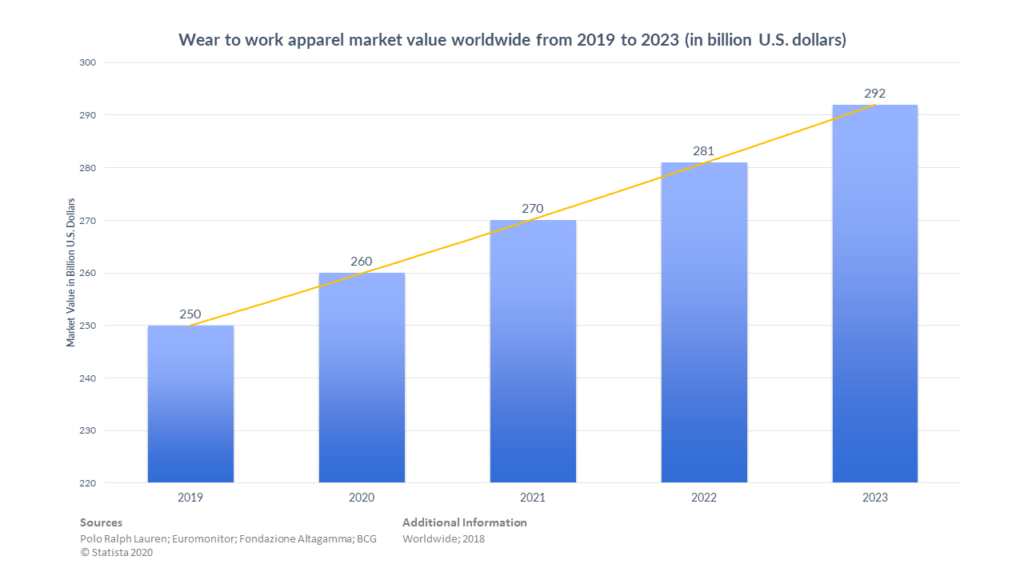
The work attire market covers clothing bought for work: corporate uniforms, industrial workwear, protective clothing, healthcare scrubs, and hospitality uniforms. It runs to tens of billions of dollars globally and grows steadily, and it is one of the more attractive apparel categories for a manufacturer because demand is contract-driven rather than fashion-driven.
What the Work Attire Market Includes
Corporate uniforms. Branded clothing for customer-facing staff in retail, banking, and services. Bought in bulk on multi-year contracts, replaced on a schedule.
Industrial workwear. Durable clothing for construction, manufacturing, and logistics, where abrasion resistance and durability matter more than appearance.
Protective clothing. High-visibility, flame-resistant, chemical-resistant, and cut-resistant garments, governed by certification standards rather than preference. This is the fastest-growing part of the work attire market and the most technically demanding.
Healthcare. Scrubs, lab coats, and antimicrobial garments, a segment that grew sharply after 2020 and held the gain.
Hospitality. Chef whites, front-of-house uniforms, and housekeeping wear.
What Drives the Work Attire Market
Regulation. Workplace safety rules mandate protective clothing in many industries, which makes a substantial part of this demand non-discretionary. Standards tighten over time, which forces replacement.
Employment growth in construction, logistics, and healthcare feeds directly into volume.
Branding. Companies increasingly treat uniforms as brand assets rather than functional necessities, which supports higher price points and more frequent redesign.
Comfort expectations. Workwear has adopted performance fabrics from activewear, with stretch, moisture management, and lighter weights now expected rather than premium.
Why the Work Attire Market Suits Manufacturing
Three things make the work attire market attractive compared with fashion apparel. Orders are large and repeat, because a company outfitting staff reorders on a schedule. Fashion risk is minimal, so inventory does not age. And relationships are long, since switching a uniform supplier is disruptive for the buyer, which favours incumbents once you are in.
The trade-off is that contracts are competitive to win, buyers are procurement professionals rather than consumers, and certification requirements in the protective segment are strict and independently tested.
Producing for the Work Attire Market
The requirements differ from fashion apparel. Durability testing matters more than appearance: abrasion, tear strength, seam strength, and colourfastness through industrial laundering, which is far harsher than domestic washing. Protective garments need certified fabrics and independent testing to the relevant standard, and the certification belongs to the finished garment rather than the fabric alone. Size ranges are wider and must accommodate a full adult population rather than a target demographic.
Branding is usually embroidered or heat-applied and must survive the same laundering, which is a specification detail that catches out suppliers new to the category.
Wrapping Up
The work attire market offers repeat orders, low fashion risk, and long relationships, in exchange for procurement-led buying and real certification requirements in the protective segment. For a brand or manufacturer it is a steadier business than fashion, and the entry barrier is technical rather than creative.
Producing uniforms and workwear, including the durability testing that decides whether a contract is retained, is covered by our clothing manufacturing service and quality assurance.