The polypropylene market has grown almost every year since 2015 and is expected to keep growing through the 2030s. Polypropylene, PP, is a thermoplastic used in packaging, automotive parts, textiles, consumer goods, and everyday food-contact items from yoghurt tubs to bottle caps, and it is the most widely used of all plastic resins for injection molding. Global demand reached about 73 million tonnes in 2025, up from 70 million in 2024 (MMR Statistics), and the polypropylene market by value is estimated somewhere between US$93 billion and US$140 billion for 2025 depending on the scope the research firm uses. Volume is the more reliable measure, and volume is rising at 3% to 4% a year.
How the Polypropylene Market Grew From 2015
Polypropylene is used across packaging, automotive, construction, textiles, and consumer goods, and the polypropylene market has expanded with every one of those sectors. Industry estimates put the market at around US$95 billion in 2015, rising through the late 2010s to a peak around US$114 billion in 2019, dipping in 2020, and recovering to new highs by 2021 and 2022. The growth came from demand for lightweight materials in automotive manufacturing and packaging, and from production technology that made high-quality PP cheaper to make. The pattern since has been steady growth in volume with more volatile prices, because PP is made from propylene and propylene prices follow oil and gas.
The Polypropylene Market Today and to 2034
Forecasts for the polypropylene market to 2034 converge on annual growth of around 4.5% to 6% by value, with the market reaching roughly US$200 billion by the early 2030s on the mid-range estimates. Asia-Pacific holds the largest share by a wide margin, at between a third and a half of global value and around 39.5 million tonnes of volume in 2024, and it is the fastest-growing region, driven by China, India, and Southeast Asia. China is both the largest producer and the largest consumer, and its petrochemical build-out since 2015, including coal-to-olefins and propane dehydrogenation capacity, has made it a net exporter of PP for the first time.
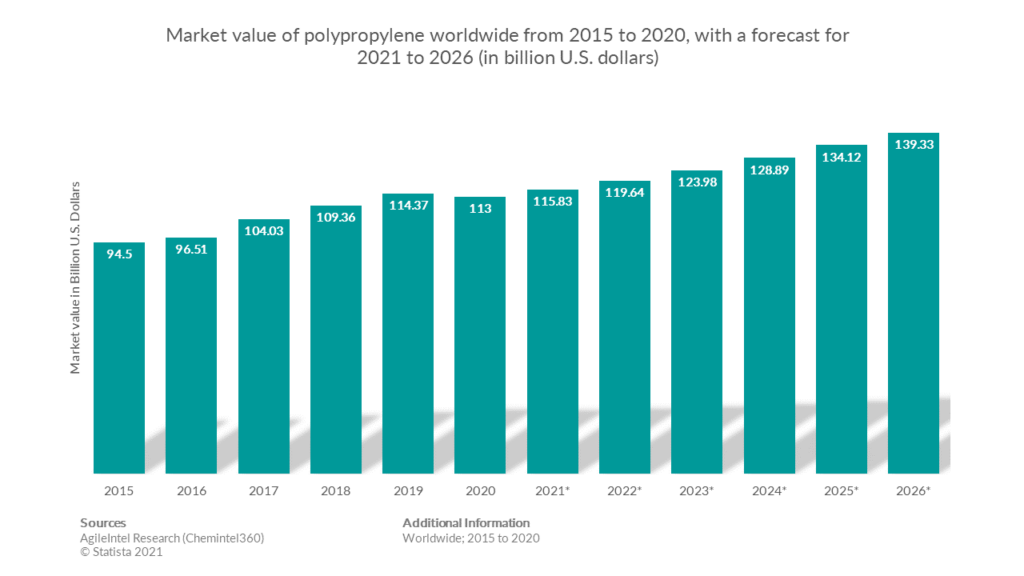
Polypropylene market value has risen most years since 2015, with volume growth steadier than price.
What Drives Polypropylene Market Demand
Three things sustain the polypropylene market. The first is packaging, which takes around a third of all PP: food containers, caps and closures, flexible films, and the rigid packaging that e-commerce has multiplied. The second is automotive, where PP’s low weight, impact resistance, and low cost make it the largest plastic in a car by weight, and where electric vehicles use more of it, not less. The third is the shift from other materials: PP replaces polystyrene in food packaging, metal and glass in containers, and heavier engineering plastics wherever its properties are adequate, because it is cheaper, lighter, and easier to recycle than most alternatives.
The constraints on the polypropylene market are regulation and feedstock. Single-use plastic bans and recycled-content mandates in the EU and elsewhere are reshaping packaging demand toward recyclable mono-material PP and recycled PP grades, which the industry is investing to supply. And PP prices track oil and gas, with the Middle East and the United States producing from cheap gas-derived propane while Europe and much of Asia crack naphtha from oil, which is why the polypropylene market’s regional price gap has widened and European producers have lost share.
The Versatile Uses of Polypropylene
Polypropylene’s combination of properties, low density, good chemical resistance, fatigue resistance, moderate stiffness, and a high enough melting point for hot-fill and dishwasher use, explains its range of uses:
- Packaging: food containers, caps and closures, bottles, flexible films, and woven sacks
- Automotive: bumpers, dashboards, interior trim, battery cases, and under-hood parts
- Consumer goods: housewares, storage, appliance parts, toys, and luggage
- Textiles: carpet fibre, ropes, nonwovens for hygiene products and medical use
- Construction: pipes, fittings, and insulation
- Medical: syringes, containers, and disposable devices
PP’s fatigue resistance allows living hinges, the thin flexible joints on flip-top caps and containers that survive tens of thousands of openings, which no other commodity plastic can match. Its weaknesses are UV sensitivity, low-temperature brittleness, and difficulty in painting or bonding, all of which can be addressed with additives and grades.
Wrapping Up
The polypropylene market is large, growing, and concentrated in Asia, and PP will remain the first resin a product designer considers for a molded part that needs to be cheap, light, and durable. For a brand sourcing plastic products, the practical points are that PP grades vary widely and the grade should be specified, that recycled PP is now available and increasingly required, and that PP prices move with feedstock, so a quote is valid for a period, not indefinitely. Choosing the right grade and the right factory for a PP part is what Intrepid Sourcing’s injection molding service does, from resin selection through mold design to production.