
As China’s growth became dependent on exports, the country became dependent on being open to trade with the rest of the world, and on the organisations that set the rules for it. Membership of trade associations makes it easier to implement common rules, to negotiate multilateral agreements, and to settle disputes, and China world trade today runs through a layered set of them: regional groups, the World Trade Organization, and the technical bodies that handle customs and trade promotion. This article covers which ones matter and what China’s position in each means for a company trading with it.
Regional Associations in China World Trade
Countries cooperate through regional economic and political associations to accelerate growth, delegating rule-making and dispute resolution to a central body. The Association of Southeast Asian Nations (ASEAN), ten countries with a combined population of nearly 700 million, is the clearest example and the most important one for China world trade. ASEAN has been China’s largest trading partner since 2020, with two-way trade over US$1.02 trillion in 2025, and the two are joined by the ASEAN–China Free Trade Area, upgraded in 2024.
The Regional Comprehensive Economic Partnership (RCEP), which ASEAN began negotiating in 2013, entered force in January 2022. It joins the ten ASEAN members with China, Japan, South Korea, Australia, and New Zealand in the world’s largest free trade agreement by population and GDP, covering about 30% of the world economy. India withdrew from the negotiations in 2019. RCEP’s cumulative rules of origin let a product made from components sourced across member countries qualify for preferential tariffs, which is what has turned China and Southeast Asia into a single integrated production region.
China world trade ambitions extend further: China has applied to join the Comprehensive and Progressive Agreement for Trans-Pacific Partnership (CPTPP), the eleven-member successor to the TPP that the United States left in 2017. The application, made in 2021, remains pending; accession would require China to meet standards on state-owned enterprises, labour, and data that it does not currently meet. The Asia-Pacific Economic Cooperation (APEC) forum, which includes both China and the United States among its 21 members, is a looser body for discussing economic issues and does not make binding rules.
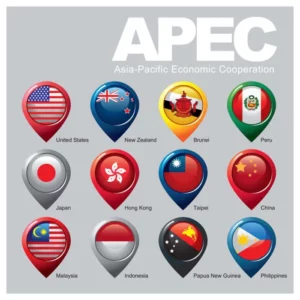
Regional and global associations set the rules under which China trades.
A Global Association: China World Trade and the WTO
The World Trade Organization has 166 members and is the framework for the tariff schedules and trade rules that govern China world trade with every major partner. China joined in December 2001 after fifteen years of negotiation, and the accession was the single most important event in modern China world trade: it ended the quotas Western countries applied to Chinese goods, gave Chinese exports permanent most-favoured-nation access to every member, and committed China to reduce its own tariffs and open its market. China’s exports grew fivefold in the following decade.
Joining bound China to WTO rules and exposed it to the dispute-settlement process, which China initially feared and has since used extensively, as both complainant and respondent. Two features of China’s WTO position still matter. First, China was admitted as a non-market economy for the purpose of trade remedies, which lets other members use surrogate-country prices in anti-dumping cases against Chinese goods. The provision was meant to lapse in 2016; the United States still treats China as a non-market economy, and the EU replaced the category in 2017 with a “significant distortions” test that reaches a similar result.
Second, the WTO’s dispute system has been largely paralysed since December 2019, when the United States blocked appointments to the Appellate Body. Panels still rule, but a losing party can appeal into the void, so a WTO ruling no longer reliably resolves a China trade dispute. The organisation remains the rulebook for China world trade; it is no longer an effective referee.
WTO accession in 2001 opened every major market to Chinese goods on equal terms.
The International Trade Centre
The International Trade Centre (ITC), the data source for most China world trade figures, is the joint agency of the WTO and the United Nations, focused on helping small and medium-sized enterprises trade internationally. It is often overlooked and unusually useful. Its Trade Map database provides trade statistics by product and country for every market in the world, its Market Access Map shows the tariffs and requirements that apply to a given product in a given market, and its export potential tools identify opportunities. For a company researching where to sell a product or where to source one, ITC’s tools are free and are the same data that the trade figures on this site come from.
China World Trade and the World Customs Organization
The World Customs Organization has 186 member customs administrations and maintains the Harmonized System, the product classification that every country’s tariff schedule is built on, including China’s. China is a member and its customs administration, the GACC, applies HS codes with Chinese national digits added. WCO membership gives China standard customs procedures and a role in setting them; for a trader it means the first six digits of a product’s tariff code are the same in China as in the EU or the United States, which is the starting point for working out what a shipment costs at either border.
What China World Trade Membership Means for a Buyer
China’s memberships decide the terms your goods trade on. WTO membership means Chinese goods enter your market at MFN rates unless your government has imposed additional tariffs, which since 2018 the United States and the EU have. RCEP means a product assembled in Vietnam from Chinese components can qualify for preferential tariffs across Asia. And the WTO’s weakened dispute system means that when a trade barrier is imposed on Chinese goods, it stays for years. Working out how those rules apply to a specific product and destination, and which route through the trading system lands it at the lowest cost, is part of what our product sourcing service does.