
A trade agreement, or trade pact, is a treaty covering taxes, tariffs, and trade rules between two or more parties. The most common kinds are preferential and free trade agreements, both designed to reduce tariffs, quotas, and other restrictions; the difference is degree, and an agreement that abolishes tariffs entirely between the parties is a free trade agreement. China trade agreements have multiplied over the past two decades, and they now determine what duty a product pays in a large share of the world’s markets.
How complex an agreement is depends on the bloc behind it. Joining the European Union means free trade with every member plus deep political and regulatory integration, and usually a shared currency. ASEAN is looser, with a framework covering goods and services among its ten members. China is not an ASEAN member but negotiates with the bloc collectively, which is how the largest of the China trade agreements came about.
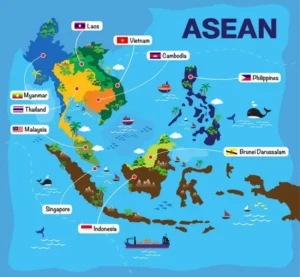
China’s network of trade agreements now covers most of Asia and a growing share of Latin America.
Current China Trade Agreements
China trade agreements now number 24 free trade agreements and preferential arrangements in force with 34 partners, and the conventional duty rates under them are published annually in the tariff schedule (2026 Tariff Adjustment Plan). The most significant are these.
RCEP, the Regional Comprehensive Economic Partnership, entered force in January 2022 and is the largest of all China trade agreements and the largest free trade agreement in the world by population and GDP. It joins China with the ten ASEAN members, Japan, South Korea, Australia, and New Zealand, covering around 30% of the world economy.
Its most useful feature for a manufacturer is cumulative rules of origin: a product assembled from components sourced across member countries can qualify for preferential tariffs, which is what has integrated China and Southeast Asia into a single production region. RCEP is also the first trade agreement between China and Japan.
ACFTA, the ASEAN–China Free Trade Area, has been in force since January 2010 and was upgraded again in 2024. It covers the largest free trade area by population, and ASEAN has been China’s largest trading partner since 2020, with two-way trade over US$1.02 trillion in 2025.
Bilateral China trade agreements are in force with Australia, South Korea, New Zealand, Singapore, Thailand, Switzerland, Chile, Peru, Costa Rica, Iceland, Georgia, Mauritius, Cambodia, Serbia, Nicaragua, and Ecuador, among others, plus CEPA arrangements with Hong Kong and Macau and the ECFA with Taiwan. Agreements with Australia and South Korea, both listed as future prospects when this article was first written, entered force in 2015 and have since been superseded in part by RCEP.
What China does not have is a trade agreement with the United States or the European Union, its second and third largest partners, and trade with both is now governed by tariffs imposed unilaterally rather than by agreement.
The Future of China Trade Agreements
China continues to pursue new China trade agreements, both for the trade flows and for the influence over standards that comes with them, and it has adopted them faster than most countries because many partners see access to the Chinese market as worth the concessions.
The largest outstanding application is to the CPTPP, the eleven-member Trans-Pacific partnership that succeeded the TPP after the United States withdrew in 2017. China applied in September 2021. Accession would require it to meet standards on state-owned enterprises, labour, data flows, and government procurement that it does not currently meet, and it needs the consent of every existing member, so it remains pending. The China–Gulf Cooperation Council agreement has been under negotiation for two decades and is periodically reported as close. Negotiations continue with Norway, Israel, and several Latin American and African partners, and an upgrade to the China–South Korea agreement covering services is under discussion.
The trend running against all of this is that China’s largest Western markets have moved from negotiating agreements to imposing measures. US Section 301 tariffs, the additional layers added from 2025, and the EU’s countervailing duties on Chinese electric vehicles are all unilateral, and the WTO’s dispute system has been unable to arbitrate them since its appellate body was paralysed in 2019. China’s response has been to deepen agreements with Asia, the Gulf, Africa, and Latin America instead, which is why trade with Belt and Road partners passed half of China’s total in 2025.

As Western markets impose tariffs, China’s agreements have deepened elsewhere.
What China Trade Agreements Mean for a Buyer
China trade agreements decide the duty on your goods, and they are worth checking product by product. If you import into a country with an agreement in force, Australia, New Zealand, Singapore, Chile, Switzerland, or an ASEAN or RCEP member, your Chinese goods may qualify for a reduced or zero conventional rate, provided you have a valid certificate of origin. If you import into the United States or the European Union, no agreement applies and the rate is the MFN rate plus whatever additional tariffs are currently in force.
RCEP’s cumulative origin rules are the most useful feature for anyone running a multi-country supply chain, because a product assembled in Vietnam from Chinese components can qualify as originating within the bloc, which a purely bilateral agreement would not allow. Working out which agreement applies to a product, what origin documentation it needs, and whether a different assembly location would land it cheaper is part of what our product sourcing service does.