
The People’s Republic of China consists of 22 provinces, five autonomous regions, four municipalities under direct central control, and two Special Administrative Regions (SARs). A SAR is under Chinese sovereignty but keeps its own legal, economic, and administrative system under the principle of “one country, two systems.” For trade purposes a SAR is treated as a separate customs territory, not as part of the mainland, and that separation is the basis of everything that makes doing business in Hong Kong different from doing business on the mainland.
SARs should not be confused with special economic zones (SEZs), which are business development zones inside the mainland. They are very different things.
The two SARs are Hong Kong and Macau. Hong Kong is by far the more significant, with a population of about 7.5 million against Macau’s roughly 700,000. Both were governed by other countries until the late 1990s: Hong Kong by Britain until 1997, Macau by Portugal until 1999.
Because of that history the two territories developed very differently from the mainland, and the handover agreements preserved their separate systems. Each has its own currency, its own courts, its own tax system, and its own border with mainland China. For a company doing business in Hong Kong, those four things are the point. Residents hold SAR passports rather than mainland ones. Since 2020 the National Security Law has applied in Hong Kong, and the mainland’s influence over the territory’s politics has grown, but the commercial and legal separation that matters to a business remains in place.
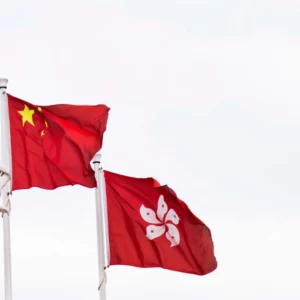
Hong Kong is the more famous and important SAR in China.
Re-Imports and Doing Business in Hong Kong as a Gateway
China has an unusually high rate of re-imports: goods that leave the country and come back. Most Western countries sit around 1% of total imports; China’s rate has historically run several times higher, and the reason is Hong Kong.
Because Hong Kong is a separate customs territory, goods crossing from Hong Kong into the mainland count as imports and goods crossing the other way count as exports, exactly as if Hong Kong were any other trading partner. China applies rules of origin to those flows, so goods that were made in China, shipped to Hong Kong, and shipped back are recorded as re-imports.
Doing business in Hong Kong for many mainland firms means using it as a processing and distribution centre, and a great deal of goods move to Hong Kong and back for logistics reasons. Some mainland manufacturers hold licences to sell abroad but not domestically, so routing goods through Hong Kong is how they reach domestic customers.
The other driver is capital control. Mainland residents and companies face strict limits on moving money out of the country. Sending goods rather than money to Hong Kong, and pricing the transaction to leave a margin in a Hong Kong account, is a long-standing way around those limits. This “fake trade” is large enough that economists treat China’s trade statistics with Hong Kong as unreliable, and it is closely related to trafficking goods between the SARs and the mainland for tax reasons.
Advantages of Doing Business in Hong Kong
Hong Kong’s proximity to the mainland is only the start of its appeal. The advantages of doing business in Hong Kong that matter most to a company sourcing from China are these.
Legal system. Hong Kong operates a common-law system inherited from Britain, with an independent judiciary and courts that international companies trust. Mainland courts can favour domestic firms; Hong Kong courts are regarded as neutral. The depth of the legal profession reflects this: lawyers, accountants, and other professional services are concentrated in Hong Kong precisely because contracts governed by Hong Kong law are easier to enforce.
Arbitration. Doing business in Hong Kong gives access to the Hong Kong International Arbitration Centre, which is one of the world’s leading arbitration venues. Awards made in Hong Kong are enforceable in the more than 170 countries that have joined the New York Convention, and, under a separate arrangement, in mainland China. For a buyer contracting with a Chinese factory, specifying Hong Kong arbitration is one of the most practical protections available.
Tax. Hong Kong’s profits tax is 16.5% for corporations, with the first HK$2 million taxed at 8.25% under the two-tier system, and 15% for unincorporated businesses. Salaries tax has a two-tier standard rate of 15% on the first HK$5 million of net income and 16% above that. Mainland China’s top personal income tax rate is 45% and its corporate rate 25%. There is no VAT, no capital gains tax, and no withholding tax on dividends. This is why so many companies trading with China are registered there: doing business in Hong Kong means paying Hong Kong tax.

Hong Kong’s separate legal and tax system is the basis of its role as a business hub.
CEPA. The Mainland and Hong Kong Closer Economic Partnership Arrangement, in force since 2004 and expanded several times since, covers trade in goods, services, and investment. Goods manufactured in Hong Kong that meet CEPA origin rules enter the mainland tariff-free, and foreign-owned companies based in Hong Kong qualify if they meet the rules. A parallel agreement exists with Macau.
Language and location. Doing business in Hong Kong also means doing business in English. Hong Kong sits at the centre of Asia, within five hours’ flight of most of the region, which makes it a natural base for a company that wants to enter China and the wider Asian market.
Macau offers similar tax advantages and its own CEPA. Its economy is dominated by gaming, which is illegal on the mainland; Macau has been the world’s largest gambling centre by revenue since 2006 and recovered that position after 2023. For most manufacturing and trading businesses doing business in Hong Kong is the more useful choice: its infrastructure, professional services, and port are built for it.
Conclusion
Hong Kong’s position rests on being different from the mainland: separate law, separate tax, a separate currency, and a reputation for neutrality. That position has come under sustained pressure from two directions. Politically, the mainland’s influence over Hong Kong has grown since 2020. Commercially, the mainland has relaxed many of its own financial rules and attracted foreign investment and professional services directly, so services that were once available only through Hong Kong are now offered in Shanghai and Shenzhen.
Doing business in Hong Kong remains the most practical base for contracting, banking, and arbitration when sourcing from China, and Intrepid Sourcing is headquartered there for exactly those reasons. What has changed is that the advantages of doing business in Hong Kong are no longer automatic: a buyer should use Hong Kong law and arbitration deliberately in supplier contracts rather than assume the territory’s status will protect them. If you want help structuring a supplier agreement that takes advantage of Hong Kong’s system, that is part of our product sourcing service.