China is better known as an exporting country, but imports to China matter enormously to the world economy. With 1.41 billion people and the largest manufacturing sector on earth, China cannot supply everything its industry and consumers need, and it is the world’s second-largest importer after the United States. Imports to China reached US$2.58 trillion in 2025 (China Customs), against exports of US$3.78 trillion, leaving the trade surplus of US$1.197 trillion covered in the balance of trade article. Most imports to China come from other Asian countries, with commodity exporters making up much of the rest.
China’s Top Imports
The largest single category of imports to China is electrical machinery and equipment, and within it integrated circuits are the largest individual product. China imports several hundred billion dollars of chips a year, more than it spends on crude oil, because its enormous electronics assembly industry consumes far more semiconductors than its own foundries can produce. That dependence is the reason semiconductors sit at the centre of the technology dispute between China and the West, and the reason China has invested so heavily in domestic chip capacity.
The figure is somewhat misleading as a measure of consumption, because a large share of imported components is assembled into products that are then exported. It is nonetheless a real dependency: an export control on advanced chips constrains Chinese manufacturing directly.
The other major categories of imports to China are:
- Mineral fuels: crude oil, natural gas, and coal. China is the world’s largest importer of crude oil (IEA), buying from Saudi Arabia, Russia, Iraq, and others, and one of the largest importers of LNG.
- Ores, slag, and ash: iron ore above all, mainly from Australia and Brazil, feeding the world’s largest steel industry.
- Machinery and computers: industrial equipment, precision machinery, and semiconductor manufacturing tools, largely from Germany, Japan, and the Netherlands.
- Optical and medical apparatus: precision instruments and medical devices.
- Vehicles: still a significant import, though far smaller as a share than a decade ago, as Chinese carmakers have taken the domestic market.
- Plastics and organic chemicals: feedstocks and intermediates that Chinese capacity does not yet cover.
- Agricultural products: soybeans above all, plus meat, dairy, and grains, under the tariff-rate quota system.
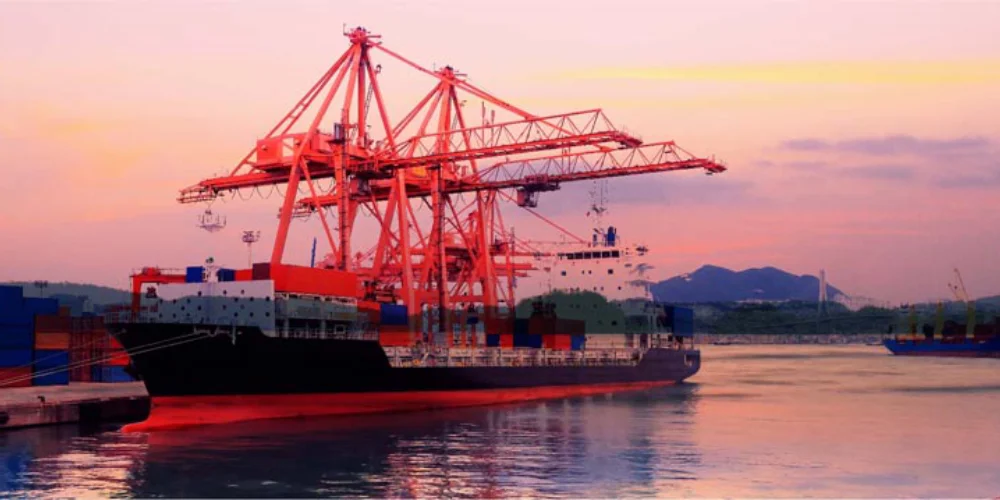
Seven of the world’s ten busiest container ports are Chinese, and they handle imports as well as exports.
Development of Imports to China
Imports to China grew rapidly for two decades after WTO accession, as manufacturing expanded and consumers grew richer. Since 2022 growth has been slower and uneven: commodity volumes have held up, while imports of finished consumer goods have been squeezed by domestic brands that now compete effectively in categories once dominated by foreign products.
The composition has changed more than the total. China imports more raw materials, energy, and high-end components than ever, and proportionally fewer finished goods, because its own industry now makes them. For a foreign company hoping to sell into China, that is the central fact: the categories where imports are growing are the ones China cannot yet make well, semiconductors, precision machinery, advanced materials, and premium branded consumer goods, and the categories where imports are shrinking are the ones where Chinese manufacturers have caught up.
Import Duties on Imports to China
Three charges apply to imports to China: customs duty, consumption tax on a defined list of goods, and VAT. They compound in that order, and the tariff barriers article sets out the calculation in full.
Customs duty rates run from zero to over 100%, with an average applied MFN tariff around 7.5%. The rate depends on the product and its origin: MFN rates for WTO members, lower conventional rates for goods qualifying under one of China’s 24 free trade agreements, zero for 43 least-developed countries, and higher general rates where no arrangement exists. The 2026 Tariff Adjustment Plan sets provisional rates below MFN on 935 tariff lines, mostly advanced components, materials, and medical products, which is a deliberate policy of cheapening exactly the imports China’s industry depends on. Additional tariffs apply to goods from the United States and Canada in response to their measures against Chinese goods.
Consumption Tax and VAT on Imports to China
Consumption tax applies only to a defined list: tobacco, alcohol, high-end cosmetics, jewellery and watches, cars and motorcycles, refined petroleum products, and a handful of others including batteries and coatings. Rates range from around 1% to 56% depending on the product, and the tax is calculated either on value, on quantity, or on both.
VAT applies to nearly all imports to China at the standard rate of 13%, with 9% for agricultural products, utilities, and books. It is calculated on the customs value plus duty plus any consumption tax, so it compounds on the other two. For a consumer product subject to consumption tax, the three charges together can add 30% or more to the CIF price, which is why landed cost for selling into China needs to be worked out before pricing rather than after.

Duty, consumption tax, and VAT compound; the order of calculation matters.
What This Means for a Business
For a company buying from China, imports to China matter indirectly: the components your Chinese supplier imports, chips, specialist materials, precision equipment, are exposed to export controls and tariffs in the countries that supply them, and a restriction there becomes a lead-time problem for you.
For a company selling into China, the practical points are that duty, consumption tax, and VAT compound and must be modelled together; that the tariff classification decides the rate, so getting the HS code right is the first step; that goods from a country with a China trade agreement may qualify for a lower conventional rate with the right certificate of origin; and that non-tariff requirements, CCC certification, Chinese labelling, and, for food, manufacturer registration under Decree 248, take longer to satisfy than the duty takes to pay. Working out landed cost and compliance in either direction is part of what our product sourcing service covers.