Choosing an electronic components manufacturer is a different decision from choosing a factory to assemble a finished product. Components — the boards, chips, passives, connectors, displays, and modules that go into a device — are made by a separate industry with its own supply chain, its own quality risks, and its own way of failing. This guide covers what an electronic components manufacturer actually does, how the process runs from design to volume production, and what to check before buying from one.
What an Electronic Components Manufacturer Makes
Electronic components manufacturer covers several distinct producers, and knowing which you need saves a great deal of misdirected enquiry.
Semiconductor manufacturers make integrated circuits and discrete devices. Leading-edge fabrication is concentrated in Taiwan, South Korea, and the United States; mature-node production, which is what most consumer and industrial products use, is widely available including in China. Global semiconductor sales reached US$791.7 billion in 2025 (Semiconductor Industry Association).
PCB fabricators make the bare printed circuit board: the laminate, the copper, the drilled holes, the solder mask. Printed circuit boards are forecast at about US$95.8 billion in 2026, a figure that has tracked close to 10% of semiconductor value for decades.
Passive component manufacturers make resistors, capacitors, and inductors, at enormous volume and very low unit cost.
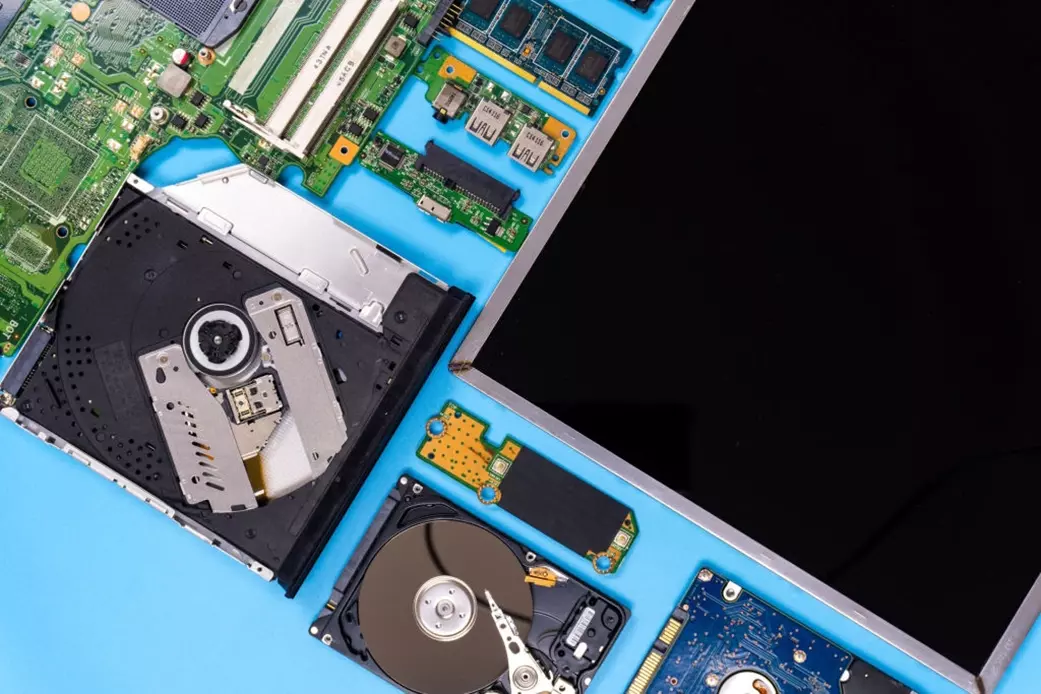
Connector, cable, and harness makers; display and touch-panel producers; battery and power-supply manufacturers; and module makers, who supply pre-certified radio modules for Wi-Fi, Bluetooth, and cellular.
PCB assemblers, who take the bare board and populate it with components. Many companies described as an electronic components manufacturer are actually assemblers, and for a brand building a finished product the assembler is usually the one that matters.
How an Electronic Components Manufacturer Works
Design
The schematic defines the circuit; the layout places it on a board. Design for manufacture happens here: trace widths above the fabricator’s minimum, component footprints that match what is actually available, test points where the tester can reach them, and a bill of materials with no single-sourced part where an alternative exists. Most production problems are design problems that nobody caught at this stage, when they were cheap.
Prototyping
A handful of boards, often hand-assembled or run on a prototype line, to prove the design works. Expect two or three revisions. This is also where certification pre-testing belongs: a radio design finalised without a pre-scan can fail FCC or CE after tooling and force a board revision.
Testing
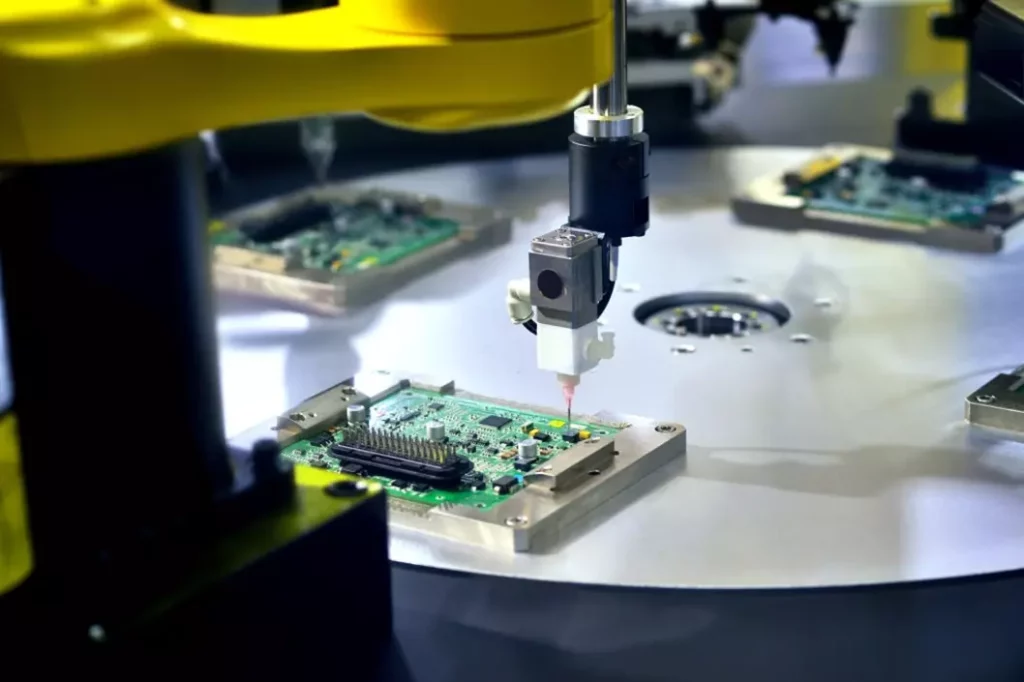
Automated optical inspection catches misplaced and missing components; X-ray inspection catches hidden joints under BGA packages; in-circuit test checks each net; functional test proves the board does what it should. An electronic components manufacturer that tests to your specification rather than its own habit is worth paying for.
Mass production
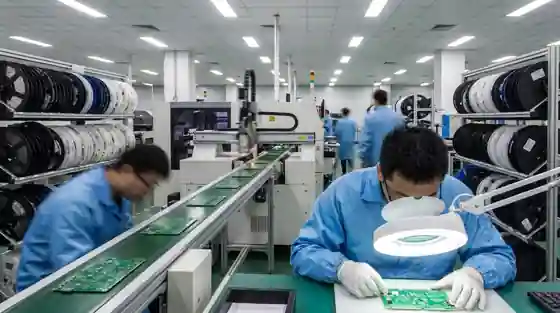
Surface-mount lines place components at thousands per hour; reflow soldering fixes them; through-hole components are added where needed; the board is inspected, tested, and either shipped as a bare assembly or built into an enclosure. The pace and consistency of this stage depend almost entirely on how well the design and the bill of materials were prepared.
Where Electronic Components Manufacturers Are Concentrated
China is home to more electronic components manufacturers than anywhere else, and is the largest producer by volume across PCB fabrication, passives, connectors, displays, and assembly, and the largest single consumer of semiconductors because so much assembly happens there. Shenzhen and the Pearl River Delta contain fabricators, assemblers, and component distributors within hours of each other, alongside the Huaqiangbei markets where nearly any part can be sourced the same day. That density is why prototype-to-production timelines are shorter there than anywhere else.
The picture is not uniform. Advanced semiconductor fabrication is not Chinese, and export controls since 2022 have constrained what Chinese producers can access. For a product using mature-node chips — most consumer and industrial electronics — that rarely matters. For anything needing leading-edge silicon, it decides the sourcing strategy. Malaysia’s Penang, Vietnam’s Bac Ninh corridor, and Mexico’s border cities have taken a growing share of assembly since tariffs reshaped supply chains.
What Goes Wrong With an Electronic Components Manufacturer
Counterfeit and remarked parts. The defining quality risk in this industry. A relabelled part, a commercial-grade part sold as industrial-temperature, or a recovered part pulled from scrapped boards will pass a visual check and fail in the field. Buying through authorised distributors, or through a manufacturer that does, is the main protection; the open component markets are fast and cheap and carry real risk.
Allocation and obsolescence. A chip that was available in volume last quarter can go to twenty weeks without warning, and a part going end-of-life mid-production forces a redesign. Specify long-lifecycle parts, qualify a second source, and order long-lead items before the rest of the bill of materials.
Assembly defects. Solder voids, tombstoning, insufficient reflow, contamination. All catchable with automated optical inspection and, for BGA packages, X-ray. A manufacturer without both is not equipped for a modern board.
Design that cannot be built as drawn. Trace widths, via sizes, and spacing below the fabricator’s process minimums add cost or make the board unmanufacturable. A design review before quoting prevents it.
Choosing an Electronic Components Manufacturer
Establish what comparable products they have built and whether they can share the buyer’s name. Ask whether they are a fabricator, an assembler, or a trading company, and request the business licence, which states the registered scope. Verify ISO 9001 and, for assembly workmanship, IPC-A-610 with the issuing body rather than accepting a scan. Confirm they buy components through authorised channels. Ask what inspection they run and whether they will accept third-party inspection before the balance is paid.
Then hold the final payment to any electronic components manufacturer until inspection passes. Factories run on thin margins and cannot afford to scrap a batch, so the condition works.
Wrapping Up
An electronic components manufacturer is one link in a chain that runs from semiconductor fab to finished device, and the link that matters most for a brand is usually the assembler. The process — design, prototype, test, production — is well understood; what separates a good outcome from a bad one is design for manufacture at the start, authorised components in the middle, and inspection before payment at the end.
Finding and verifying the right manufacturer, reviewing the design before quoting, and inspecting before shipment is what our electronics production package covers, with PCB assembly and PCB design inside it. The electronic components industry report covers the market in detail, and the guide to PCB types covers the boards themselves.