
The service robots market has moved from a curiosity to one of the fastest-growing parts of manufacturing in under a decade. A service robot is any robot that performs useful work for humans outside industrial production: warehouse transport, cleaning, agriculture, surgery, hospitality, and domestic tasks. Global sales of professional service robots reached almost 200,000 units in 2024, up 9%, and consumer service robots reached 20.1 million units, up 11% (International Federation of Robotics, World Robotics 2025). By value, estimates for the service robots market cluster around US$43 billion for 2025, with forecasts putting the service robots market above US$200 billion by the early 2030s at a compound growth rate above 20%.
That growth rate is the highest of any category covered on this site, and the reason is not novelty. Two structural forces are driving it: labour shortages in developed economies, which make automation a necessity rather than an efficiency play, and ageing populations, which are driving demand for medical and assistive robots faster than any other segment.
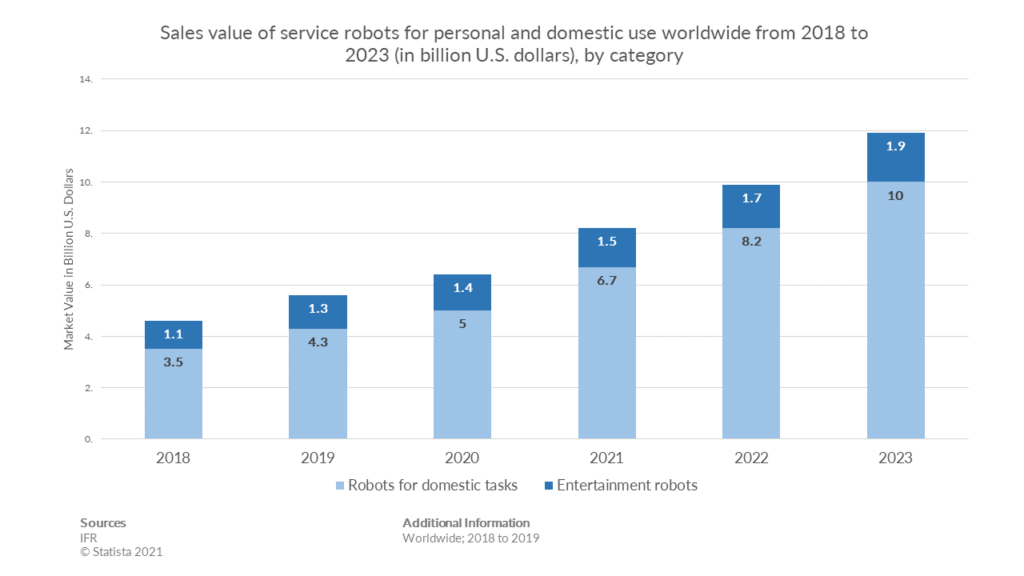
Service robots market sales value worldwide. Professional and consumer robots have grown on different curves.
Professional Service Robots Market by Application
The IFR’s 2025 data breaks the professional service robots market into clear application groups, and the ranking is more useful than the headline number.
Transportation and logistics leads by a wide margin, at 102,900 units in 2024, up 14%. These are the autonomous mobile robots that move goods around warehouses and factories, and they are more than half of all professional service robots sold. This is the segment that has matured: the companies making AMRs have grown into established manufacturers rather than startups.
Hospitality robots are second at over 42,000 units, though down 11%. These handle guidance, information points, telepresence, and increasingly food and beverage preparation.
Professional cleaning grew 34% to more than 25,000 units, mostly floor cleaning. Agriculture follows at close to 19,500 units, down 6%, and security and search-and-rescue at 3,100 units, up 19%.
Medical robots grew fastest of all, up 91% to around 16,700 units, with rehabilitation and non-invasive therapy robots more than doubling. The IFR counts medical robots as a separate category from service robots under ISO standards, but they belong in any picture of where the service robots market is going, and demographic change means that growth is structural rather than cyclical.
The Consumer Side of the Service Robots Market
On the consumer side the service robots market is far larger by volume: consumer robots outnumber professional ones by a hundred to one: 20.1 million units sold in 2024. Domestic task robots, overwhelmingly vacuum and floor cleaners, account for 97% of that. Lawn mowing, window cleaning, and pool cleaning make up most of the rest. Robots for care at home remain a genuine niche, with only 536 units recorded, because unstructured home environments and human-centric tasks demand a level of safety and capability the technology has not reached at consumer prices.
For a brand, the consumer segment is where the service robots market is accessible. A domestic robot is a consumer electronics product: an enclosure, motors, sensors, a battery, a control board, and firmware. The supply chain that makes phones and appliances makes these too.
Robot-as-a-Service Is Changing How Robots Sell
One shift matters commercially more than the unit numbers. Robot-as-a-service, where a customer subscribes or rents rather than buying outright, grew 42% in 2024, and the RaaS fleet grew 31%. Companies are adopting automation without heavy upfront capital, which lowers the barrier for the customer and changes the economics for the manufacturer: recurring revenue instead of a one-time sale, and a much stronger reason to care about reliability and serviceability in the product design.
If you are developing a robot product, the RaaS question should be settled before the design is: a machine you will maintain and refurbish over years needs different construction, different serviceability, and different component choices from one sold outright.
Who Supplies the Service Robots Market
The service robots market is unusually fragmented: the IFR is aware of 944 producers worldwide, excluding prototyping services and system integrators, which makes the service robots market far more fragmented than industrial robotics. It is also consolidating: the wave of new entrants in the 2010s has slowed sharply, partly because segments like warehouse AMRs have matured, and partly because entrepreneurial energy has moved from hardware to software and AI.
That second point is the opportunity for a product company. The differentiator in service robots is increasingly software and AI rather than mechanics, and the mechanical platform — chassis, drivetrain, sensors, power, enclosure — can be manufactured by a contract manufacturer rather than built in-house. That is a very different proposition from ten years ago, when building a robot meant building a robot company.
Where the Service Robots Market Is Manufactured
The service robots market is supplied largely from Asia, for the same reasons as the rest of electronics. China installed 295,000 industrial robots in 2024, 54% of global deployments, and Chinese manufacturers outsold foreign suppliers in their home market for the first time, taking 57% domestic share. That domestic robotics industry sits on top of the electronics supply chain that makes motors, sensors, batteries, displays, and control boards available at consumer prices within a few hours of each other.
For a brand developing a service robot, that concentration is the practical reason to manufacture in Asia: the motor supplier, the battery supplier, the PCB assembler, the enclosure moulder, and the final assembler can all sit in the same province. Building the same product in Europe or North America means importing most of those components anyway.
What This Means for a Product Company
A service robot is a harder product than most consumer electronics, and the difficulties are specific. Battery certification is mandatory and non-trivial: UN38.3 for transport, IEC 62133 for the cell, and, for larger packs, additional testing. Motor and drivetrain selection determines whether the robot works at all and is where most first-time designs fail. Safety certification depends on the application, and a robot operating near people falls under standards that a static appliance does not. And serviceability has to be designed in, because a robot that cannot be repaired economically kills a RaaS business model.
None of that makes the category inaccessible, and the growth rate makes it one of the more attractive product opportunities in electronics. It does mean the design and manufacturing partner matters more than in a simpler product. Intrepid Sourcing’s electronics production package covers electronics design, prototype development, and production for exactly this kind of product, and the plastics production package covers the enclosure and moulded parts that go with it.
Wrapping Up
The service robots market is growing faster than almost any other manufacturing category, driven by labour shortages and demographics rather than by fashion. Professional robots are led by warehouse logistics and growing fastest in medical; consumer robots are dominated by domestic cleaning; and robot-as-a-service is changing how both are sold. The manufacturing base is in Asia, the differentiator is increasingly software, and the mechanical platform is something a contract manufacturer can build. For a company with a robotics product idea, that combination is more favourable than it has ever been. The consumer electronics industry report covers the wider supply chain these products draw on.