
Thermoplastics are the materials most manufactured goods are made from: the housings on electronics, the interiors of cars, the pipes in buildings, and nearly all packaging. Thermoplastic production has grown almost every year for seventy years, and the forecasts to 2050 have it continuing. Global plastics production reached 430.9 million tonnes in 2024, up 4.1% on the year, and is projected to reach 589 million tonnes by 2050 (Plastics Europe, Statista). Thermoplastics are the large majority of that total, because they can be melted and reshaped repeatedly, which makes them the only plastics suited to high-volume processes such as injection molding and extrusion.
The growth has straightforward causes: population growth and urbanisation drive demand for housing, infrastructure, and consumer goods, and improvements in polymer technology keep making thermoplastics cheaper, stronger, and more capable relative to the metal, glass, and wood they replace. Most mass-produced thermoplastic items are made by injection molding, which is very cheap at scale, and that cost advantage is what has kept thermoplastic production rising through decades of environmental pressure.
Thermoplastic Production Forecast to 2050
The direction of the thermoplastic production forecast is consistent across sources even where the absolute numbers differ. Global plastics output has grown at a compound rate of around 4.8% since 2009, and forecasts have it continuing at a slower but positive rate for the next quarter-century, reaching roughly 589 million tonnes by 2050 on Statista’s projection. Some scenarios put it higher, above 700 million tonnes, and some lower if recycling and regulation bite harder than expected, but no mainstream forecast has thermoplastic production falling before 2050.
The regional pattern is clearer than the total. Asia produced 57.2% of the world’s plastics in 2024, China alone 34.5%, and both shares are rising. Europe’s share has collapsed from 22% in 2006 to 12%, and European production has been flat or falling since 2018 under high energy costs. North America holds a middle position on cheap shale gas feedstock. Any thermoplastic production forecast is, in practice, a forecast about Asian capacity.
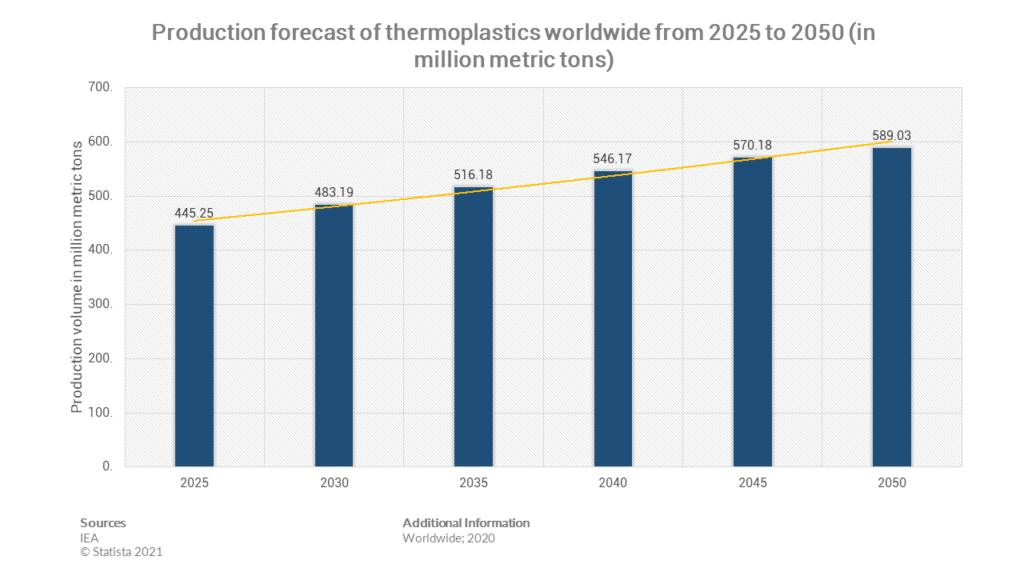
Global thermoplastic production is forecast to keep rising to 2050, with Asia taking a growing share.
What Is Driving Increased Thermoplastic Production
Four forces sustain the thermoplastic production forecast.
Population and urbanisation. More people living in cities means more housing, infrastructure, vehicles, appliances, and packaged goods, and thermoplastics are in all of them. Construction alone takes around a fifth of plastics demand.
Substitution. Thermoplastics keep displacing other materials because they are lighter and cheaper: plastic pipe instead of copper, plastic components instead of machined metal, plastic packaging instead of glass. Vehicle lightweighting is the clearest case, and electric vehicles use more plastic than combustion ones, not less.
New applications. Engineering thermoplastics, PEEK, PPS, polycarbonate blends, and glass-filled grades, are taking work that metals used to do, in medical devices, electronics, and aerospace, at a fraction of the weight.
Feedstock capacity. The petrochemical build-out in China and the Middle East since 2015 has added enormous capacity for the ethylene and propylene that thermoplastics are made from, and that capacity has to run. Cheap feedstock in the US from shale gas has done the same. Supply has been pushing the thermoplastic production forecast as much as demand has been pulling it.
Working against all of this is regulation and recycling. Single-use plastic bans, recycled-content mandates, and extended producer responsibility rules are reshaping demand toward recyclable mono-materials and recycled resin. Circular plastics from recycled and bio-based sources passed 43.9 million tonnes in 2024, over 10% of global output for the first time, and that share is the fastest-growing part of thermoplastic production even as the total keeps rising.
The Largest Thermoplastic Markets
Packaging is the largest end use of thermoplastics worldwide, at roughly 40% of demand, followed by building and construction at around 20%, automotive at 9% to 10%, electrical and electronics at around 6%, and household, agriculture, and everything else making up the rest. By resin, polypropylene and the polyethylenes are the largest volumes, with PET, PVC, polystyrene, and ABS behind them. Thermoplastic composites, thermoplastics reinforced with glass or carbon fibre, are a small but fast-growing segment concentrated in automotive and aerospace, where the ability to reshape and recycle a composite gives thermoplastics an advantage over the thermoset composites they compete with.
Wrapping Up
The thermoplastic production forecast to 2050 is for continued growth, concentrated in Asia and increasingly composed of recycled and bio-based material alongside virgin resin. For a brand having plastic products made, three things follow. Supply is not a constraint; capacity is ample and growing, and it is mostly in China. Price will keep tracking oil and gas, so quotes have a shelf life.
And the composition of demand is shifting toward recyclable and recycled materials faster than the headline volumes suggest, which makes material choice a compliance decision in an increasing number of markets. Choosing the right thermoplastic and the right process for a product is what our plastics production package handles, and the plastics manufacturing process guide covers how each process works.