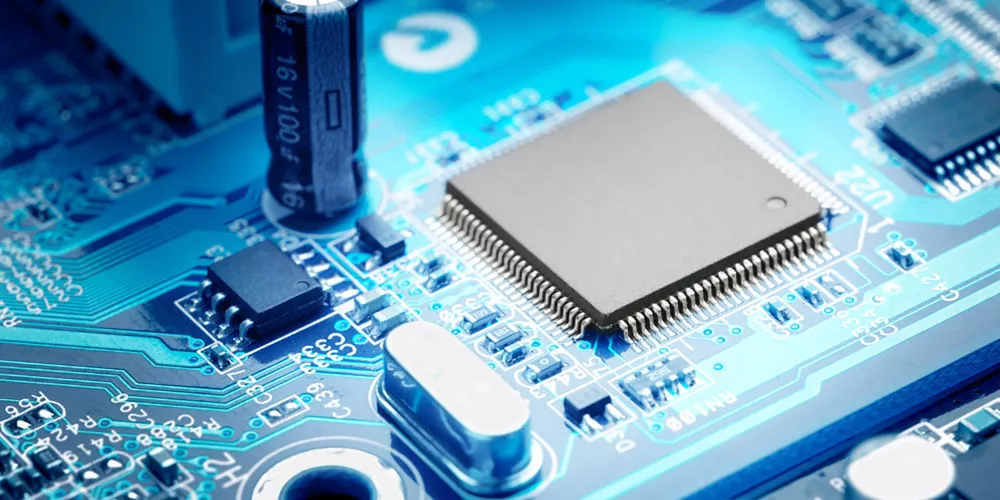
Integrated circuit types are the vocabulary of modern electronics, and the integrated circuit itself is the most consequential invention in the field, and it is why the computer that once filled a room now fits in a pocket. Before ICs, circuits were built from discrete components: bipolar junction transistors, diodes, field-effect transistors, resistors, and capacitors, each soldered separately onto a board in circuit board manufacturing. A discrete circuit can be repaired one component at a time. An integrated circuit fabricates all of those components permanently onto a single piece of semiconductor, usually silicon, so that a complete circuit becomes a single component. That is what allows a modern phone to contain billions of transistors.
For anyone developing an electronic product, knowing the main integrated circuit types matters for a practical reason: the ICs on your bill of materials determine what your product can do, what it costs, and how hard it will be to source.
Integrated Circuit Types: Analog, Digital, and Mixed
The broadest division among integrated circuit types is between analog and digital ICs, with mixed-signal chips combining both. Below those are integrated circuit types defined by function and by how the chip is built.
Analog IC
In an analog IC the input and output signals are continuous, and the output is a function of the input level. Audio and radio-frequency amplifiers are the classic examples, and they are among the most common analog ICs made by electronics manufacturers. Operational amplifiers, voltage regulators, comparators, and timers are other everyday analog ICs. Every product with a sensor, a speaker, or a battery contains several.
Digital IC
Digital ICs work with binary signals, where a low voltage represents 0 and a high voltage represents 1. Logic gates such as AND, OR, NAND, and XOR, flip-flops, counters, memory, and microprocessors are all digital ICs. The microcontroller at the heart of most consumer products is a digital IC, and so is the memory that stores its firmware. Digital ICs are the ones most hobbyists meet first, in development boards and starter kits.
Mixed-Signal Integrated Circuit
A mixed-signal IC combines analog and digital circuits on a single chip. Any system that converts analog signals to digital data or back, which is nearly every product with a sensor or a display, needs one. Analog-to-digital converters, digital-to-analog converters, and most wireless radio chips are mixed-signal. Clocks and timing devices are another common example. Modern systems-on-chip integrate analog, digital, and radio functions on one die, which is why a smartwatch can be so small.
Logic Gate Integrated Circuit
Logic gate ICs are the integrated circuit types that produce a logical output from combinations of inputs. The classic families are the transistor-transistor logic (TTL) 7400 series and the 4000 series CMOS ICs, both still in production decades after their introduction. The SN7408, a quad two-input AND gate in a plastic dual in-line package, is a typical TTL logic IC. In production electronics, discrete logic gates have largely been absorbed into microcontrollers and programmable logic, but they remain useful for simple glue logic and in education.
Timer Integrated Circuit
A timer IC generates precise timing intervals or oscillations. The 555 timer, designed at Signetics in 1971 and released in 1972, is the most produced IC in history and is still manufactured in enormous volumes. It works as a monostable timer, an astable oscillator, or a pulse generator, in 8-pin or 14-pin dual-timer packages. Timers appear in everything from flashing indicators to power-supply control.
Hybrid Integrated Circuit
Hybrid ICs are the integrated circuit types built from separate individual components, chips and passive components, mounted on a ceramic substrate and interconnected by metallisation patterns or bonding wires. Because the passive components can be trimmed to precise values, hybrid ICs achieve performance that monolithic chips cannot match, at higher cost. They are used in low-volume, high-performance applications such as power modules, RF modules, and military and medical electronics.
Monolithic Integrated Circuits
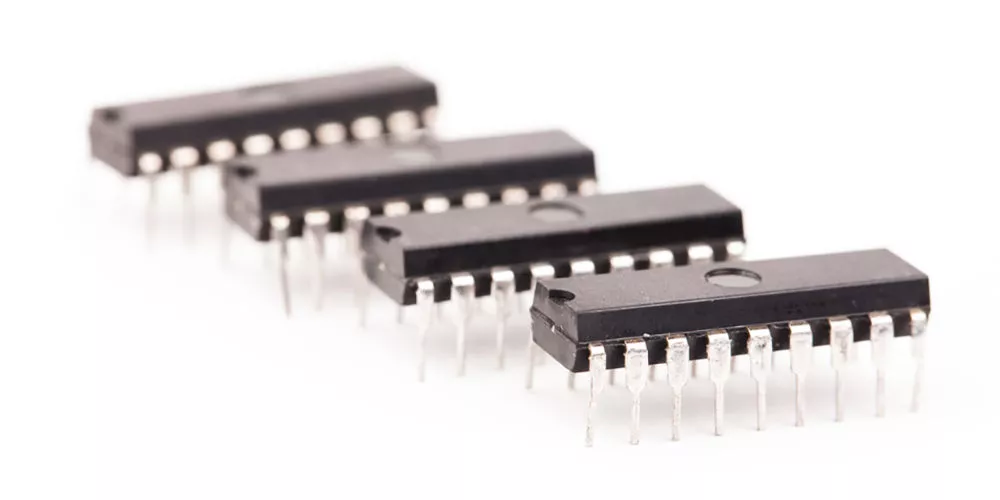
A monolithic IC forms all of its active and passive components, and the interconnections between them, on a single silicon chip. The name comes from the Greek mono, single, and lithos, stone. Monolithic ICs are by far the most widely produced of all integrated circuit types because of their low cost at volume and their reliability, and they are what most people mean when they say “chip.” Microprocessors, memory, voltage regulators, amplifiers, and radio receivers are all monolithic. The trade-offs are limited power handling and imperfect isolation between components on the same die, which is why power electronics often still use hybrid or discrete designs. Choosing between monolithic and hybrid approaches is part of circuit design for any new product.
Amplifier Integrated Circuit
Amplifier integrated circuit types fall into two broad kinds: operational amplifiers and audio amplifiers. An operational amplifier has two inputs, inverting and non-inverting, and a single output, and it amplifies the difference between them by a very high gain; with external feedback it becomes the building block for filters, sensor interfaces, and signal conditioning. Audio amplifier ICs drive speakers and headphones in televisions, phones, computers, and every product with sound; Class-D audio amplifier ICs, which are highly efficient, are now the standard in portable and battery-powered devices.
Switching Integrated Circuit
Switching ICs control the flow of current, turning circuits on and off or between states. In power electronics they are the core of switch-mode power supplies, battery chargers, and motor drivers, where switching regulators convert one voltage to another with high efficiency. In signal applications, analog switches and multiplexers route signals between circuits. Nearly every powered product contains switching ICs in its power stage.
Thick-Film and Thin-Film Integrated Circuits
Thick-film and thin-film ICs deposit passive components, resistors and capacitors, as films on an insulating substrate, with transistors and diodes added as separate chips. Thick-film circuits are screen-printed and fired; thin-film circuits are deposited by vacuum processes to finer tolerances. Both are forms of hybrid construction, used where precise passive values, high power, or high frequency matter more than the cost advantage of a fully monolithic chip.
Uses of the Main Integrated Circuit Types
Integrated circuit types come in every form and size, from a three-pin voltage regulator to a processor with over a hundred billion transistors. Common applications include:
- Computers, phones, and tablets
- Televisions and displays
- Audio amplifiers and speakers
- Wearables and smartwatches
- Radar and communications equipment
- Memory and storage devices
- Timers and clocks
- Motor control and power supplies
- Kitchen and household appliances
- Automotive and medical electronics
What Integrated Circuit Types Mean for Your Product
For a brand developing an electronic product, the integrated circuit types on the bill of materials are usually the most expensive components and the ones most exposed to supply risk. Integrated circuits were China’s second-largest export product in 2025 at over US$200 billion, and the largest single import, which shows how global and how concentrated the supply chain is. A good electronics design uses ICs that are available from more than one distributor, avoids parts near end-of-life, and specifies alternates where possible. That is part of what our PCB design and electronics production services cover.