
A trade war is what happens when two or more countries deliberately impose trade disadvantages on each other, usually to protect domestic producers from imports or as a political manoeuvre. The economic effects are lower trade volumes, damaged industries, and job losses on both sides; the political effects are strained relations and, historically, WTO cases. The phrase “China currency war” belongs to an older version of this argument, when the accusation was that China kept the yuan artificially cheap to win export share. That accusation has largely been overtaken by events, and what replaced it is a tariff conflict of a very different kind.
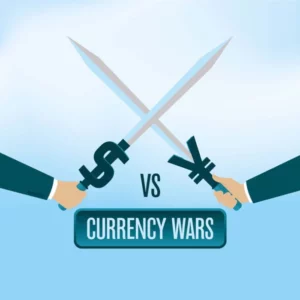
The China Currency War Argument
The China currency war case, made most loudly in the 2000s, was that China held the renminbi below its market value to make its exports cheap and imports expensive, and that this explained its growing trade surplus. There was substance to it at the time: the yuan was effectively pegged to the dollar, and the central bank accumulated enormous foreign reserves keeping it there.
What happened next undercut the argument. The yuan appreciated substantially between 2005 and 2014, and by 2015 the International Monetary Fund concluded it was no longer undervalued. Since then it has moved in both directions with the dollar cycle, weakening through 2022 to 2024 and strengthening modestly in 2025. The United States formally designated China a currency manipulator in August 2019 and removed the label five months later.
The current criticism is narrower and more accurate: not that the yuan is deliberately cheap, but that the process setting it is opaque. The People’s Bank of China publishes a daily reference rate and allows trading within a 2% band, managed against a basket rather than the dollar alone, with capital controls making that management possible. The monetary policy article covers the mechanics.
From China Currency War to Tariff War
The conflict that actually arrived was not a China currency war at all. It was about tariffs, not exchange rates. Section 301 duties on Chinese goods began in 2018 and have been layered on since, and the current structure stacks several measures on the same product: Section 301 tariffs, Section 232 duties on steel and aluminium, product-specific anti-dumping and countervailing duties, and the base most-favoured-nation rate. For Chinese-origin goods, stacked duties reach 35% to 60% depending on category and classification.
China has retaliated with tariffs of its own, and increasingly with a different instrument: export controls. Licensing requirements on gallium, germanium, graphite, and, since 2025, rare earths and rare-earth processing technology give China leverage over inputs that foreign electronics and defence industries cannot easily replace. That is a more precise weapon than currency management ever was.
The Customs Side of the China Currency War
Beyond the China currency war argument, customs measures do the work that tariffs cannot. Anti-dumping duties target goods sold below normal value, countervailing duties target subsidised goods, and both are applied to Chinese products regularly by the United States, the European Union, India, Brazil, Turkey, and others. Rules-of-origin enforcement has become a live issue as production shifts to Vietnam and Mexico, with investigations into whether goods are genuinely transformed there or merely transshipped.
The most consequential recent change for smaller importers: the United States eliminated the $800 de minimis exemption in February 2026. Every shipment now requires formal customs entry with classification, origin verification, and full duty payment, including samples and prototypes.

Why the WTO Has Not Resolved the China Currency War
Historically a dispute of this scale, whether over a China currency war or tariffs, would go to the WTO. That route is largely closed: the Appellate Body has been unable to function since December 2019, because the United States blocked appointments to it, so a losing party can appeal a ruling into a void where it never becomes binding. Countries have responded by acting unilaterally, which is why the measures of the past several years have been imposed rather than litigated.
What the China Currency War Means for a Buyer
The practical translation of all this for someone importing goods is straightforward. Tariffs in your destination market are now the largest single variable in landed cost, and they change with politics rather than with markets. The managed yuan means the currency will not adjust to absorb those tariffs, so the cost lands on the importer. And where a product is assembled has become a pricing decision, which is why “China plus one” is now a standard structure rather than a hedge.
The old China currency war framing is worth understanding mainly because it explains how the argument got here. What matters operationally is the tariff stack on your specific product, and working that out is part of what our product sourcing service does. The article on reducing US import tariffs covers the strategies available.