
ODM manufacturing lets you use a supplier that already makes the product you want. You can only make limited changes to an existing product, but using an existing production line is cheaper and faster than starting from a blank sheet, and it gives you access to the supplier’s engineering and economies of scale. For most first products, ODM manufacturing is the right place to start.
ODM stands for “original design manufacturer”: a company that designs products as well as manufactures them, and sells them to other companies who rebrand them as their own. ODM manufacturing is one of the main routes through the sourcing process.
ODM manufacturing output is commonly sold as white label or private label goods, made in bulk so that smaller companies benefit from the ODM’s scale and expertise. The two terms are often used as synonyms and should not be. A white label supplier sells the same generic finished product to many retailers, each of whom brands it. A private label supplier makes a finished product exclusively for one retailer, usually with some customisation. Many suppliers offer both, and which you get depends on the product and the volume.
Both routes cut the cost and time of bringing a product to market and let you concentrate on the parts of the business that differentiate it. ODM manufacturing is often confused with OEM, original equipment manufacturer. With an OEM, the factory makes a product or component to your design and specification. With an ODM, you are buying a product the factory already designed and putting your brand on it. OEM is more work and more control; ODM is less of both.
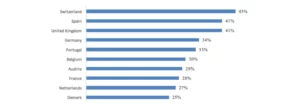
Private label has grown from a discount option to a mainstream retail strategy.
Advantages and Disadvantages of ODM Manufacturing
The biggest advantage of ODM manufacturing, for white label and private label alike, is that you do not spend time and money designing the product. You put that effort into your brand, your channel, and your customers, and you borrow the ODM’s engineering and manufacturing experience instead of building your own.
You will usually pay less per unit than you would producing the product yourself or through an OEM. There is no design cost to recover, and the ODM’s volume across all its customers gives you a price that reflects their scale, not your order size. It is common to share a supplier with well-known brands in the same category without knowing it.
You will also move faster. Designing a product and setting up a custom production line takes months; an ODM product is close to ready. That time goes into branding, packaging, and market testing, and it means you can test a category with a small order before committing to a custom development.
The disadvantages follow from the same facts. Your product is not unique, and competing products on the market may be very close to identical. Differentiation has to come from the brand, the packaging, the channel, and the service, or margins will be competed away. A sourcing partner can help you find ODMs whose products are less widely distributed, which reduces that problem without eliminating it.
ODM manufacturing also suits only certain products. If your product needs a specialised design, or if an off-the-shelf product will not do, ODM manufacturing is the wrong route and an OEM or full custom development is the right one. The ideal ODM manufacturing product is one where the product itself is fairly standard but brand, price, and presentation make a large difference; basic consumer goods and accessories are the classic examples.
ODMs will usually alter a product to your specification in colour, size, materials, and finish, but not always as far as you want, and often only above a higher minimum order. The only way to know how flexible a supplier really is, and how good its workmanship is, is by ordering samples.
Focus on building your brand by leaving product design to a supplier that has already done it.
Industries Taking Advantage of ODM Manufacturing
ODM manufacturing serves many industries. Supermarket own-brand ranges in food, cosmetics, and household goods are the most visible case: in almost every category the retailer’s own label shares a supplier with a national brand and differs only in packaging and price.
Consumer electronics accessories are the largest ODM manufacturing category coming out of China: power banks, chargers, cables, earbuds, phone cases, and small appliances are overwhelmingly ODM products sold under hundreds of brands. The same is true of e-cigarettes and vaping hardware, where a handful of Shenzhen manufacturers supply most of the world’s brands, and of generic pharmaceuticals, where a few manufacturers produce the active product that many brands package and sell.
Consumer attitudes to own-brand and private label products have shifted decisively. Price is still the main reason people buy them, but in most Western markets a majority now say private label quality matches or beats the national brand, and private label share of grocery sales in Europe passed 40% in the mid-2020s. That acceptance is what makes ODM manufacturing viable as a brand strategy rather than only a discount strategy, though attitudes still vary by country and category, which matters for how you position the product.
ODM Manufacturing in China
Most ODM manufacturing across most product categories happens in China. The exact number of ODM suppliers is impossible to count, but the sector has grown steadily for two decades as Chinese manufacturers have moved from making other people’s designs to making their own.
Offering white label and private label products requires a factory to design products, which means building engineering and industrial design capability. That transition, from OEM assembler to ODM designer, is the story of Chinese manufacturing since around 2010. Automation, operational sophistication, and in-house R&D have let traditional OEM factories take on design conceptualisation as well as production, and the value added, and the margin, is higher for it. It is also why the same factories are now capable of the full custom development that OEM clients want.
The majority of ODM contracts in China are white label, because white label orders are smaller and more numerous and the factory can sell the same product to many customers. That is what gives a buyer access to a ready-designed product at low cost, still open to customisation and branding with your own logo. The largest ODM categories in China are consumer electronics and accessories, apparel and textiles, jewellery and accessories, furniture and home goods, and, increasingly, personal care and small appliances. Apparel is particularly easy to adapt, and there are many white label clothing manufacturers as a result.
The Chinese ODM manufacturing market is mature and crowded. It is led by very large firms, BYD, Pegatron, and Inventec among them in electronics, that serve global brands and have little interest in small orders, and by a much larger tier of mid-sized and small ODMs that take the low-volume work the large ones no longer accommodate. That second tier is where most new brands find their supplier, and the choice within it is wide enough to scale with your volume.
In theory very simple: put your logo on an existing product. That is the basic principle of ODM production.
Common Tasks in White Label and Private Label Manufacturing
The scope of work for an ODM manufacturing project, white label or private label, normally includes the following.
Cost Estimate
Cost estimation compares the prices offered by different suppliers for the finished product, and the things that are not in the unit price: shipping, production turnaround, supplier quality, packaging, and the cost of any customisation. Knowing the market rate at each price and quality level lets you set your costing and your pricing before you commit.
Lead Time Assessment
Delivering fast is an advantage over competitors, and lead time assessment is what makes a delivery date reliable. Supplier estimates cannot be taken at face value. Managing lead time from order placement to receipt, and knowing where the time actually goes, is what gets a product to market in the shortest time the supply chain allows.
Sample Procurement
An ODM’s workmanship is judged from actual samples, not from a catalogue. Sample procurement lets you verify that a supplier can produce the product to the quality claimed, and it screens out suppliers who promise more than they can deliver, which is a common way to be let down.
Supplier Assessment
Supplier assessment establishes which suppliers have the technical skill and experience to make your product, at your quantity, on your timeline, without a drop in quality. It should include an on-site visit and inspection of the supplier’s business licence, local registration, testing certifications, product certifications, and workforce. That is how you learn how the product is actually made.
Due Diligence
Due diligence is the background check: confirming that a supplier holds the certifications it claims, complies with the standards and regulations that apply, and has a track record with previous clients and the financial stability to still be there next year. It is the best available indicator of whether a supplier relationship is worth entering.
Private Label Packages
A private label package from a sourcing partner takes care of the back end, design adaptation, quality, and production setup, so that you can concentrate on the front end: branding, marketing, sales, and customer service. The scope of a private label package varies and may cover design only, production only, or both, together with packaging, pre-shipment quality control, and logistics and customs clearance. Done properly, it lets you take the advantages of ODM production without the risks that come from running it alone.