China is not one factory. It is a set of specialised city clusters, and knowing which cluster makes your product is the difference between a good quote and three wasted weeks. Understanding China manufacturing cities by product is the first step in any sourcing project, before you shortlist a single supplier.
The scale is easy to forget. China exported 26,989.0 billion yuan of goods in 2025, up 6.1%, with industrial value added of 41,682.6 billion yuan according to the National Bureau of Statistics of China. None of that is spread evenly across the map.
High-tech manufacturing made up 17.1% of value added among larger industrial enterprises and grew 9.4%, which tells you the country is still moving up the value chain rather than simply making more of the same.
Why China Manufacturing Cities by Product Matter More Than the Country?
China manufacturing cities by product exist because suppliers, skilled labour and logistics concentrate around a category, then feed each other. A factory in the right cluster can source a component the same day. A factory in the wrong one orders it from the right cluster and adds a week.
That is why a supplier search across the whole country produces quotes that cannot be compared. Two factories 1,500 km apart have different component access, different labour markets and different ports.
So the useful sequence is to identify the cluster first, then shortlist inside it. It narrows the search and it improves the quotes you get back.
It also changes how a supplier reads you. A buyer who approaches the right cluster with the right question looks like someone who has done this before, and that affects both the price and the attention you get.
The Two Great Manufacturing Regions
Almost all China manufacturing cities by product sit in one of two river deltas, and the two have different characters.
The Pearl River Delta
The most export-oriented China manufacturing cities by product sit here, in Guangdong province in the south, anchored on Shenzhen, Dongguan and Guangzhou. It is China’s largest provincial economy with 2025 GDP of CN¥14.58 trillion and the largest population of any province at around 128 million.
This is electronics, consumer goods, apparel and toys. It is also the most export-oriented region in the country, with decades of experience handling Western buyers.
The Yangtze River Delta
Zhejiang and Jiangsu provinces around Shanghai. This is textiles, plastics, moulds, hardware, machinery and small commodities.
The delta tends toward smaller specialised towns rather than megacities, each dominating one product line. It is where you go for a moulded part, a fabric or a household item rather than a smartphone.
Electronics: Shenzhen and Dongguan
Of all the China manufacturing cities by product, Shenzhen is the most obvious answer and usually the right one for electronics. It became China’s first special economic zone on 1 May 1980 and now records 2025 GDP of CN¥3,873 billion, with Huawei, Tencent and DJI headquartered there.
Dongguan, immediately north, is the volume partner. It holds a population of 10.57 million and 2024 GDP of ¥1.228 trillion, ranking as the fourth largest export region in China with $65.54 billion in shipments, and hosting facilities for Samsung Electronics and Nokia among others.
Use Shenzhen for development, prototyping and complex assembly. Use Dongguan when the design is settled and volume matters more than iteration speed. Our guide to Shenzhen electronics manufacturing covers the split in detail.
Apparel and Fabric: Guangzhou, Humen and Keqiao
Alt text: Rolls of fabric stacked in a Chinese textile wholesale market
Apparel splits across two deltas, which surprises buyers who expect all the China manufacturing cities by product for clothing to sit together.
Guangzhou and the surrounding towns handle garment production, with Humen long established as a garment manufacturing town. Shantou, further along the coast, concentrates on underwear and knitwear.
Fabric is a separate question. Keqiao in Shaoxing, Zhejiang, holds the largest textile market in the world, and many Guangdong garment factories buy their material from it. That matters for your lead time, because your fabric and your sewing may sit 1,300 km apart.
So when you plan a clothing production run, ask where the fabric comes from as well as where the sewing happens. The answer changes your timeline more than the unit price does.
Moulds and Plastics: Taizhou, Ningbo and Yuyao
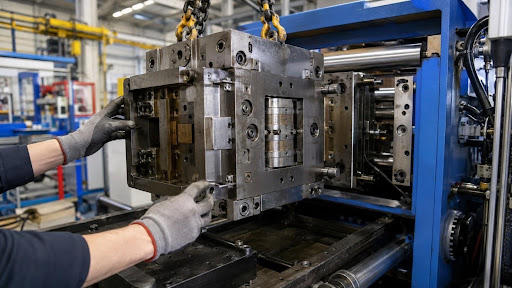
Anything injection moulded points to Zhejiang, and specifically to a cluster around Taizhou. It is the clearest single-category example of how China manufacturing cities by product actually work.
Huangyan district in Taizhou is the centre of it. It is recognised as a significant plastic mould manufacturing hub, and as of 2006 was producing 70% of China’s plastic moulds, with around 70% of electric bike plastic components originating in the area.
Yuyao, further north, specialises in plastic products rather than the tooling itself. Ningbo provides the deep-water port for both, which is why the cluster grew where it did.
For a plastics production project, this cluster gives you tooling and moulding within driving distance of each other, and that proximity is what keeps a mould revision to days rather than weeks.
Furniture and Homeware: Foshan and Shunde
Furniture concentrates in Foshan, immediately west of Guangzhou, with Shunde district as its centre. It covers upholstered and case furniture, kitchen cabinetry, lighting and bathroom fittings.
The cluster is worth knowing about for a reason beyond furniture itself. Its hardware and fittings suppliers serve other categories, so a product needing hinges, castors or brackets may draw on Foshan even when the main assembly sits elsewhere.
Ceramics and homeware sit partly here and partly in Chaozhou further along the coast, with Jingdezhen inland retaining a long ceramics tradition. Among China manufacturing cities by product, homeware is the least concentrated category on this list.
Small Commodities and Hardware: Yiwu
Yiwu in Zhejiang is the answer for low-value, high-variety goods: stationery, toys, hardware, accessories, party goods and household items. It is the odd one out among China manufacturing cities by product, because it is a market rather than a factory town.
The Yiwu International Trade City is the world’s largest wholesale market for small commodities, covering 5,500,000 square metres with over 75,000 stores across several districts.
It is a trading market rather than a factory floor, which cuts both ways. You can find almost anything quickly, and you are usually buying through a trader rather than from the maker. For a first order that is often fine. For a custom product it is worth tracing back to the factory.
Yiwu is also the fastest way to understand what already exists in a category. Walking a district for an afternoon shows you the going rate, the standard variations and the packaging conventions, which is expensive information to gather any other way.
A Quick Map of China Manufacturing Cities by Product
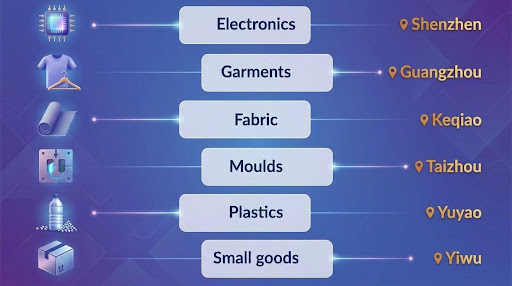
Use this table of China manufacturing cities by product to narrow a search before you approach anyone. Each row is a starting point rather than the only option.
Product | City or cluster | Region |
|---|---|---|
Electronics, PCB, assembly | Shenzhen, Dongguan | Pearl River Delta |
Garments and cut-and-sew | Guangzhou, Humen, Shantou | Pearl River Delta |
Fabric and textiles | Keqiao, Shaoxing | Yangtze River Delta |
Moulds and tooling | Taizhou, Huangyan | Yangtze River Delta |
Plastic products | Yuyao, Ningbo | Yangtze River Delta |
Small commodities, hardware | Yiwu | Yangtze River Delta |
Furniture | Foshan, Shunde | Pearl River Delta |
Ceramics and homeware | Chaozhou, Jingdezhen | Coastal and inland |
How Clusters Affect Your Lead Time?
China manufacturing cities by product shape your calendar as much as your unit price, and they do it in three places.
Component Distance
A factory buying inside its own cluster restocks in a day or two. A factory buying from another delta adds transit, and adds it again on every revision during sampling.
The Inland Leg to the Port
Pearl River Delta goods usually leave through Shenzhen, Guangzhou or Hong Kong. Yangtze Delta goods leave through Shanghai or Ningbo. A factory positioned well for its port saves days that never appear on a quotation.
Chinese New Year
Every cluster closes around the same holiday, and the closure runs far longer than the public holiday itself. Whichever of the China manufacturing cities by product you choose, that annual shutdown needs planning from the previous autumn.
When the Cluster Is Not the Whole Answer?
Three complications are worth knowing before you treat a cluster as a guarantee.
Trading Companies Sit in Every Cluster
Being in the right city does not make a supplier a factory. Verify the business scope on the licence, because trading and manufacturing are different registrations. Knowing which one you are dealing with changes how you price and how you audit.
Your Product May Span Two Clusters
An electronic product in a moulded housing draws on Shenzhen for the board and Taizhou for the tooling, so two China manufacturing cities by product are involved from the start. Someone has to coordinate that, and if it is not your supplier, it is you.
Clusters Move Slowly, but They Move
Rising wages in the coastal deltas have pushed some labour-intensive work inland, to provinces such as Jiangxi, Hunan and Anhui, and some out of China entirely. Confirm where a category sits now rather than relying on older guidance.
The pattern is usually that the assembly moves and the component supply stays. A factory that relocated inland may still buy its parts from the coast, which is worth asking about because it affects both cost and lead time.
What to Do With This?
Four steps turn a map of China manufacturing cities by product into a working shortlist.
- Identify the cluster that matches your product category
- Check whether your components sit in the same cluster or another one
- Verify each supplier’s business licence and scope before quoting
- Confirm which port your goods will leave from and the inland leg to it
That last step is the one buyers skip. A cheaper factory three provinces from a port is not cheaper once the inland freight and the extra days are counted, and that is true across every one of the China manufacturing cities by product listed here.
Then apply the ordinary checks: a verified entity, a complete specification, and an inspection plan agreed before production starts. Our guide to a manufacturing quality control process covers what that plan should contain.
Every better product starts here.
Production Readiness Checklist
Delivered directly to your inbox.
Final Thoughts
Start With the Map, Not the Search
Most sourcing time is wasted approaching the wrong cities. A working map of China manufacturing cities by product turns a scattered search into a focused one, and focused searches produce quotes you can actually compare.
Pick the cluster, verify the suppliers inside it, and plan for the components that sit elsewhere. That sequence works whether you are making one product or ten.
One more habit worth building. Write down which China manufacturing cities you used by product for each component and why, because that record is what makes your second product faster to source than your first.
If you want a shortlist built in the right cluster for your product, tell us what you are making, and we will match it to the cities that suit it.