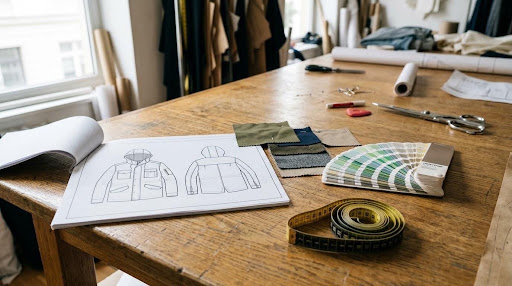
A tech pack template gives a factory what it needs to sample and produce a garment: flat sketches, a bill of materials, measurements with tolerances, construction details, labelling and packing instructions. A template only helps when every section is complete. Anything left blank becomes a decision the factory makes for you, which is why the tech pack comes before sampling in any clothing production project.
What Should a Tech Pack Template Include?
A tech pack template should include flat sketches, a bill of materials, colourways and artwork, then the measurement, construction, labelling and packing sections covered further down. Start with the three sections below, because everything else refers back to them.
1. Flat Sketches
Flat sketches are technical drawings of the front and back, drawn to scale, with no shading or model. Call out every seam, pocket, trim and closure. Add close-ups for details such as collar shape or pocket construction.
2. Bill of Materials
The bill of materials lists every component that goes into the garment:
- Main fabric, with composition, weight in GSM and width
- Lining and interlining
- Trims such as zips, buttons and drawcords
- Thread, with colour references
- Labels, hangtags and packaging
Fabric width matters too, because it decides how many pieces the factory can cut from each metre.
3. Colourways and Artwork
List every colourway with Pantone or supplier references. Add print or embroidery artwork with exact placement, measured from a fixed point such as the high point shoulder. Request lab dips to approve each colour before bulk fabric is dyed.
How Should a Tech Pack Template Handle Measurements and Construction?
A tech pack template should handle measurements and construction with numbers the factory can check, not descriptions it has to interpret. Three sections do that work.
1. Measurement Specification
The measurement specification sets out the required dimensions for the sample size, including areas such as the chest, sleeve, and other key garment measurements. Each point needs a tolerance, for example plus or minus 1 cm. Without tolerances, there is no agreed basis for passing or failing a garment during quality control.
Add a how-to-measure diagram showing exactly where each point is taken. Two inspectors measuring from different starting points can record different values for the same garment.
2. Grading
Grading shows how each measurement changes across sizes. Supply a full size chart, or state the grade rule between each size.
3. Fit and Sample Comments
Add a comments page to the tech pack template for each sample round. Record the measured value, the target, the difference and the correction you want. That history stops the same fit issue coming back in bulk production.
4. Construction Details
Construction details specify stitch types, seam allowances, seam finishes, stitches per inch and reinforcement points. Each choice affects both cost and durability, so none of them should be left open.
5. Packing Instructions
Packing instructions tell the factory how the finished garment leaves the line. Cover these points:
- Folding method and size of the fold
- Polybag size, material and warning text
- Hangtag position and attachment
- Units per carton and size ratio
- Carton markings and shipping labels
Who Should Create the Tech Pack?
The tech pack should be created by the brand, or by a technical designer working for the brand, because it records decisions only the brand can make. Fabric, fit, finish and labelling are commercial choices, not factory choices.
If the factory writes the tech pack, the specification tends to reflect its own materials and methods. Owning the document also makes it easier to move production later, since any competent factory can quote from the same pack. Update it after every approved sample, so bulk production always follows the version you signed off.
What File Format Should a Tech Pack Template Use?
A tech pack template should be shared as a locked PDF for reference, with the editable source file kept alongside it. Spreadsheets and design software both work for smaller brands, while larger brands often manage tech packs in product lifecycle management software.
Whatever the format, put a revision number and date on every page. When a factory samples from an old version, the revision number is the fastest way to find out why.
A Tech Pack Template Checklist
Run through this list before a tech pack template goes to any factory. If a line is blank, the factory will fill it in for you.
- Front and back flat sketches
- Bill of materials with fabric weights
- Measurement specification with tolerances
- Grade rules for every size
- Construction and stitching details
- Artwork, colourways, labels and packing
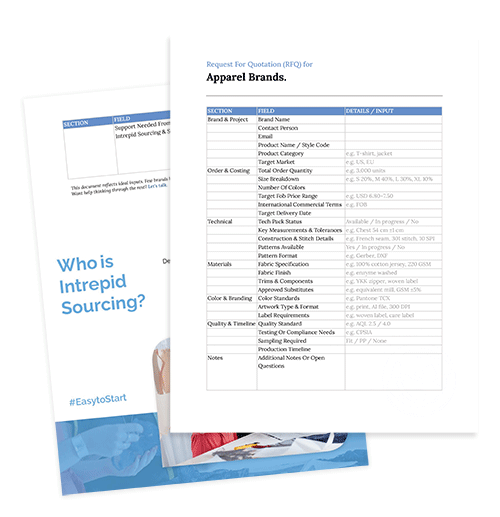
Every better product starts here.
Production Readiness Checklist
Delivered directly to your inbox.
Why a Complete Tech Pack Shortens Sampling?
Each gap in a tech pack becomes a question, and each question adds a round of emails before a sample can be cut. A complete tech pack template lets the factory quote accurately and sample closer to your intent. It is also one of the items on our apparel production readiness checklist.
The finished pack then becomes the reference for approving samples and inspecting bulk production, as our guide to clothing manufacturers explains in more detail.
If your tech pack template still has gaps, our tech pack designers can complete it and take the design straight into sampling.