The expanded polystyrene market has grown steadily for a decade and is forecast to keep growing to 2030 and beyond, despite the regulatory pressure on the material. Expanded polystyrene, EPS, is the rigid plastic foam most people know as styrofoam, and it is used across packaging, construction insulation, and automotive manufacturing. Estimates of the expanded polystyrene market vary by scope, but they cluster around US$15 billion to US$20 billion in 2025, growing at roughly 4% to 5% a year, with Asia-Pacific holding the largest share of both production and consumption.
The material’s appeal is straightforward. EPS is about 98% air by volume, which makes it extremely light; it insulates better than almost anything at its price; it absorbs shock; and it can be moulded into any shape a product needs. That combination is why the expanded polystyrene market has resisted every substitute proposed for it, and why it supports such specific plastic design applications.
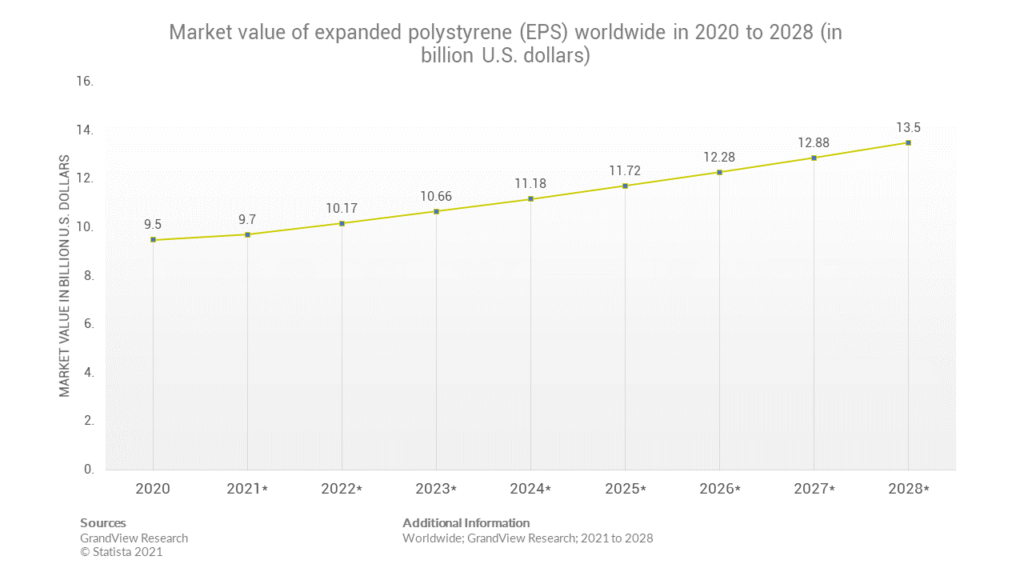
Expanded polystyrene market value worldwide. Growth has been steady rather than dramatic.
Expanded Polystyrene Market Value Worldwide
The global expanded polystyrene market was valued at around US$9.5 billion in 2020 and passed US$10 billion for the first time in 2022. It has continued climbing since, and current estimates for 2025 range from roughly US$15 billion to US$20 billion depending on whether the figure counts raw EPS resin, converted products, or both. Forecasts to 2030 put compound annual growth at 4% to 5%, which would take the expanded polystyrene market past US$25 billion by the early 2030s on the broader measures.
Treat any single figure for this market with care. EPS is measured inconsistently across research firms, and the gap between the narrowest and broadest definitions is more than double. The direction is consistent across all of them: steady growth, led by Asia.
What Drives Demand in the Expanded Polystyrene Market
Construction. The largest single end use, and the one growing most reliably. EPS insulation board is cheap, effective, and light, and tightening building energy codes across Europe, China, and North America have raised the volume of insulation used per building. This is the part of the expanded polystyrene market least exposed to the packaging bans.
Electronics packaging. EPS moulded to fit a product absorbs shock better than almost any alternative at the price, which is why it protects appliances, televisions, and electronic devices in transit. Rising consumer electronics demand in China and India, driven by an expanding middle class and rising incomes, has grown this segment substantially. Anyone shipping fragile goods from Asia is buying EPS whether or not they think about it.
Cold chain and food. EPS boxes carry fish, produce, pharmaceuticals, and vaccines because the insulation performance per unit of cost is unmatched. Growth in pharmaceutical cold chain has offset some of the losses in food service.
Automotive. EPS is used in energy-absorbing bumper cores and headrests, and lightweighting pressure in vehicle design has kept that demand stable.
The Regulatory Pressure on the Expanded Polystyrene Market
The honest counterweight to the growth story is regulation, and it is more advanced than most market forecasts acknowledge. The EU’s Single-Use Plastics Directive banned EPS food and beverage containers across all member states from July 2021. In the United States, bans on EPS food service products now cover a dozen states including California, New York, New Jersey, Washington, Colorado, Maryland, and Maine, alongside many cities. Canada, Australia, India, China, and several other countries have introduced their own restrictions.
Those bans target food service specifically, not EPS as a material, which is why the expanded polystyrene market has kept growing through them: construction insulation, protective packaging, and cold chain are untouched and together represent the great majority of volume. What the bans have done is redirect the market rather than shrink it.
Recycling is the second pressure. EPS is recyclable, and the industry has built collection and densification infrastructure in Europe and Japan, but its low density makes transport uneconomic over distance, and global recycling rates remain low. Recycled-content requirements now appearing in packaging regulation will affect the expanded polystyrene market more than the food service bans did.
Alternatives and What They Mean
Substitutes exist for most EPS applications: moulded pulp and corrugated for protective packaging, mycelium and starch-based foams for some cushioning, mineral wool and PIR board for insulation, and expanded polypropylene where a tougher, recyclable foam is needed. Each performs on some dimensions and not others, and all cost more than EPS today.
For a brand choosing packaging, that trade-off is now a commercial decision rather than a technical one: EPS is cheaper and performs better, but it is banned in specific applications, it is increasingly unpopular with retailers, and it may not meet recycled-content rules in your market. Working out which materials are permitted and which perform for a specific product is part of what our custom packaging service does.
Wrapping Up
The expanded polystyrene market is larger than it was, growing at a moderate and consistent rate, and concentrated in Asia. Its growth comes from construction insulation, protective packaging, and cold chain rather than the food service uses that regulation has removed. For anyone specifying packaging or plastic parts, EPS remains the cheapest way to insulate or protect a product, with a compliance question attached that did not exist a decade ago. The plastics manufacturing process guide covers how EPS and other foams are produced, and our plastics production package covers material selection and production for plastic products.