
The market for high density polyethylene is one of the largest in plastics. HDPE is used in packaging and food storage, in construction, in pipe, and in automotive components, because it is strong, chemically resistant, and cheap. The market for high density polyethylene was worth around US$70.7 billion in 2020 and has grown steadily since, tracking demand for packaging, pipe, and consumer goods, and it is one of the largest single segments of the global plastics industry.
Two demand drivers stand out. E-commerce has multiplied packaging demand, and HDPE is the material of bottles, caps, jerrycans, drums, and heavy-duty film. And infrastructure has added a second, less visible driver: HDPE pipe has replaced metal in gas and water distribution across most developed markets, because it does not corrode and can be welded into continuous runs. Both are structural rather than cyclical, which is why the market for high density polyethylene keeps growing through periods when other plastics do not.
The Market for High Density Polyethylene Today
Global plastics production reached 430.9 million tonnes in 2024, up 4.1% on the year, and the polyethylenes, HDPE, LDPE, and LLDPE together, are the largest resin family within it (Plastics Europe, The Fast Facts 2025). The market for high density polyethylene specifically is forecast to keep growing at low-to-mid single digits a year through the early 2030s, with the volume growth concentrated in Asia and the value growth affected by feedstock prices, since HDPE is made from ethylene and ethylene tracks oil and gas.
That feedstock link explains the regional pattern. The United States and the Middle East make ethylene from cheap gas-derived ethane; Europe and much of Asia crack naphtha from oil; and China has added coal-to-olefins capacity that no other producer uses at scale. The cost gap between those routes decides which regions export HDPE and which import it, and it has widened since 2022.
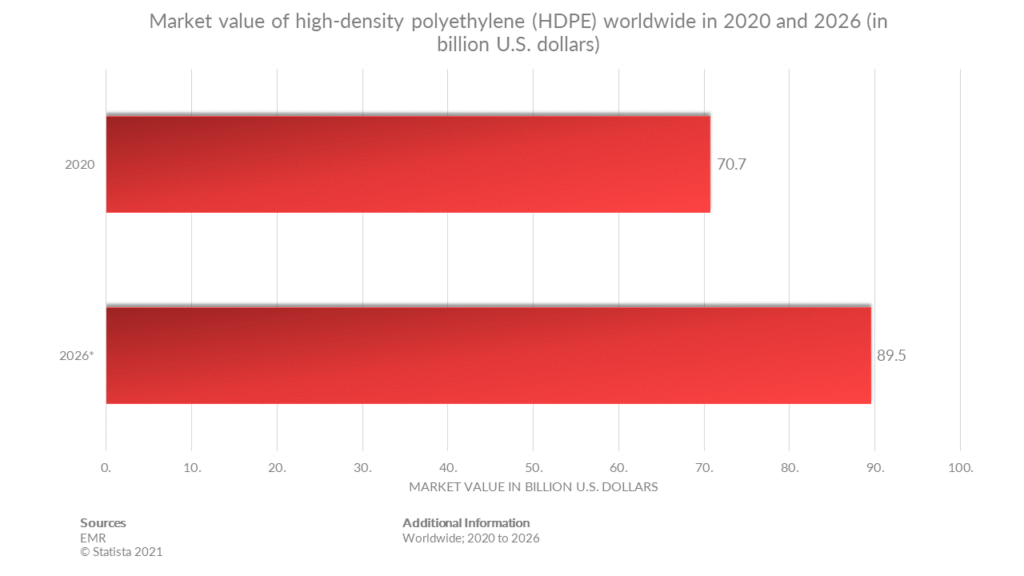
The market for high density polyethylene has grown steadily, with volume growth concentrated in Asia.
Factors Behind Growth in the HDPE Industry
Four things sustain the market for high density polyethylene. Packaging is the largest, and e-commerce has increased it: bottles for household and personal care products, caps and closures, drums and jerrycans for industrial liquids, and heavy-duty films and sacks. Pipe and infrastructure is the fastest-growing: HDPE has become the standard material for gas and water distribution, and replacing ageing metal networks is a multi-decade programme in most developed countries.
Consumer and industrial goods take a substantial share, in crates, bins, tanks, toys, and housewares. And recycling has become a driver rather than only a constraint: HDPE is one of the most readily recycled plastics, recycled HDPE is available at scale, and recycled-content requirements in the EU and several US states now push demand toward it.
Working against growth are the same forces acting on all commodity plastics: single-use restrictions, extended producer responsibility rules, and consumer sentiment against plastic packaging. In practice these have reshaped the market for high density polyethylene more than they have shrunk it, pushing demand toward recyclable mono-material designs and recycled resin, both of which favour HDPE over harder-to-recycle alternatives.
Asia-Pacific Leads the HDPE Market
Asia-Pacific is the largest and fastest-growing region in the market for high density polyethylene, driven by China, India, and Southeast Asia. Asia produced 57.2% of the world’s plastics in 2024 and China alone 34.5%, and Chinese petrochemical capacity added since 2015 has turned the country from a large net importer of polyethylene into a much smaller one, with new capacity still coming online. India is the fastest-growing consumer.
For a buyer, that concentration means HDPE resin and HDPE products are cheapest and most available in Asia, and that a European or American brand sourcing HDPE packaging is very likely sourcing it from there whether or not it knows.
HDPE Market Segmentation
By feedstock
HDPE is made by polymerising ethylene, which comes from naphtha cracking, from ethane and other natural gas liquids, or, in China, from coal or methanol. Bio-based ethylene from sugarcane ethanol produces chemically identical bio-HDPE at a premium, and mechanically recycled HDPE is now a feedstock in its own right for non-food applications.
By application
- Rigid packaging: bottles, caps, jerrycans, drums, and containers, the largest single application
- Pipe and fittings: gas, water, drainage, and cable ducting
- Film and sheet: carrier bags, liners, and heavy-duty sacks
- Injection-moulded goods: crates, bins, pallets, housewares, and toys
- Blow-moulded industrial products: tanks, fuel containers, and large hollow parts
By manufacturing process
HDPE is processed by blow molding for bottles and hollow containers, injection molding for solid parts, extrusion for pipe, film, and sheet, and rotational molding for large tanks. Which process a product uses decides which HDPE grade it needs, since melt flow and density differ by application, and specifying the grade rather than just the material is what prevents a part that warps or cracks.
Wrapping Up
The market for high density polyethylene is large, growing, concentrated in Asia, and increasingly shaped by recycled-content requirements rather than by virgin resin economics alone. For a brand sourcing HDPE products, the practical points are that grade matters and should be specified, that recycled HDPE is available and increasingly required in Europe, and that resin prices move with feedstock, so a quote has a shelf life. Selecting the right grade and process for an HDPE product, and finding a factory that runs it well, is what Intrepid Sourcing’s plastics production package covers, from CAD design through tooling to production.