
The consumer electronics industry never stands still. Products become obsolete within a product cycle, the supply chain reorganises itself around every new tariff, and the technology that was premium three years ago is now in a US$30 device. If you are developing an electronic product, this report gives you the market picture, the reasons China remains the production base, and the problems you will meet if you set up production there without help.
Consumer Electronics Industry Overview & Key Statistics
a. Consumer electronics industry description
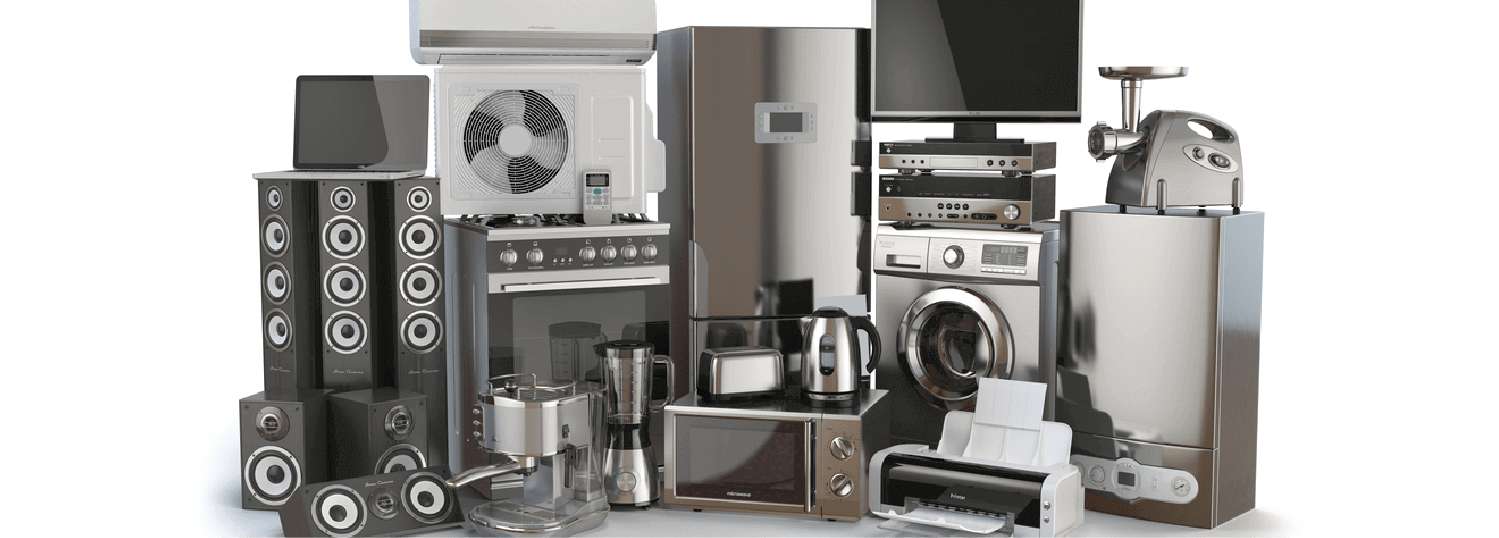
Consumer electronics are electronic devices designed for personal and household use. The industry has traditionally been divided into brown goods, meaning communication and entertainment devices such as televisions, smartphones, tablets, audio, and computers, and white goods, meaning household appliances such as refrigerators, washing machines, and built-in kitchen systems. The fastest-growing categories today sit between the two: smart home devices, wearables, and connected personal-care products.
White goods should not be confused with white label manufacturing. White goods are a product category. White label is a way of producing goods, in which a factory supplies a generic product, such as a power bank, earbuds, a monitor, or a charger, to retailers who sell it under their own brand. Custom products are engineered for one client; white label products are broadly the same for every buyer in that category.
China is the world’s largest producer of consumer electronics, particularly brown goods. It has the most extensive electronics manufacturing ecosystem and supply chain on earth, with more electronics suppliers than the rest of Asia combined and a manufacturing workforce in the hundreds of millions.
The global consumer electronics market is worth US$1.03 trillion in 2026, with telephony the largest segment at US$521 billion, and is projected to grow 2.8% a year to 2030 (Statista Market Insights, 2026). China is the largest single market as well as the largest producer, at US$221 billion in 2026; the United States is the largest per-capita market, with the Consumer Technology Association forecasting US consumer technology revenue of US$565 billion in 2026 (CTA, January 2026).
b. Global consumer electronics production: China vs. other regions of the world
China dominates the consumer electronics industry by output. Its electronic information product exports reached US$758.3 billion in 2025, up 7.2% on the year and accounting for one-fifth of the country’s total goods trade, according to the China Chamber of Commerce for Import and Export of Machinery and Electronic Products (CCCME). The composition is shifting: integrated circuit exports rose 26.8% to US$201.9 billion, while smartphone exports fell 7.7% by volume and 9.4% by value, and computer exports slipped 1.4%, as manufacturers moved final assembly of US-bound devices to Vietnam, India, and elsewhere in response to US tariffs. Exports to the United States fell 18.9% in 2025 while shipments to ASEAN, the EU, and emerging markets rose.
The broader electrical machinery and equipment category (HS 85), which covers semiconductors, smartphones, batteries, and solar cells, is China’s largest export category at roughly US$928 billion in 2024, about 26% of all Chinese exports (China Customs). Taiwan, South Korea, and Japan remain the other major electronics producers in the region, concentrated in semiconductors, displays, and components rather than finished consumer devices.
Two things follow for a buyer. The final-assembly step for consumer devices is now genuinely available outside China, at some cost in supply-chain depth. And the component supply chain, from chips to displays to batteries, is more concentrated in China than it was five years ago, not less.
c. Commonly produced consumer electronics industry goods in China
- Smartphones and tablets
- Laptops and desktop computers
- LED and OLED televisions and monitors
- Wireless earbuds, headphones, and speakers
- Wearables: smartwatches, fitness trackers, smart rings
- Smart home devices: cameras, plugs, lighting, thermostats
- Drones and action cameras
- Power banks, chargers, and cables
- Personal-care electronics: electric toothbrushes, hair tools, massagers
d. Year-on-year consumer electronics industry growth
China’s high-tech product exports grew 11.9% in the first three quarters of 2025 to 3.75 trillion yuan, contributing more than 30% of overall export growth (China Customs, October 2025). Within electronics the growth is in components and industrial products rather than finished consumer devices: chips, batteries, and equipment are growing fast, while smartphone and computer exports are flat to declining as assembly diversifies.
China’s share of global smartphone assembly has fallen from around three-quarters in 2017 to well under two-thirds today, with India and Vietnam taking the difference. That is a change in where the last step happens, not in where the industry lives: the components in an Indian-assembled phone are still overwhelmingly Chinese.
Why China is the Right Choice for Consumer Electronics Production
a. Consumer electronics production capacity
For large-scale production in the consumer electronics industry, China remains the default. Shenzhen, the “Silicon Valley of hardware,” is home to thousands of high-tech enterprises, design houses, and product integrators, and it serves the premium brands of the world, Apple, Sony, Nintendo, Dell, Microsoft, and Huawei among them, through Chinese suppliers largely unknown in the West, with Foxconn the exception.
China’s advantage is supply-chain density. A smartphone requires around 2,000 different components, from machine screws and capacitors to circuit boards and displays, and all of them are sourced within a few hours’ drive of Shenzhen. That density, from automated giants like Foxconn to small workshops, is what lets a Chinese factory turn a custom design into a functional prototype and then into production volume faster than anywhere else.
b. Technological advantages and automation in the consumer electronics industry
China has automated faster than any other manufacturing economy. According to the International Federation of Robotics‘ World Robotics 2025 report, 295,000 industrial robots were installed in China in 2024, 54% of all installations worldwide and the highest annual total any country has recorded. China’s operational stock exceeds 2 million robots, about 4.5 times Japan’s, the largest in the world. For the first time, Chinese robot makers sold more in their home market than foreign suppliers did, with a 57% domestic share. The IFR expects Chinese demand to keep growing around 10% a year to 2028.
Measured against China’s very large workforce, robot density stands at 166 per 10,000 manufacturing employees under the IFR’s revised methodology (IFR, April 2026), well behind South Korea’s 1,220 and Germany’s 449. The gap is the opportunity: there is a great deal of Chinese electronics manufacturing still to automate, and the state-directed investment behind Made in China 2025 and its successors is aimed squarely at it.
c. Modern logistics infrastructure
The consumer electronics industry depends on logistics, and China’s logistics sector is the largest in the world by volume, built on two decades of investment in ports, rail, and road. Seven of the world’s ten busiest container ports are Chinese. The network gives offshore clients visibility of a shipment from factory gate to destination port, and it is the reason a Chinese factory can commit to a lead time that a factory elsewhere cannot.
China’s well-developed supply chain is why manufacturers such as Foxconn, DJI, and Anker are based there. Producing in one’s home country means components crossing continents before they arrive at the assembly line, with the compliance and traceability problems that brings. Outsourcing to an electronics supplier in China puts the components and the assembly in the same place.
Potential Problems in China’s Consumer Electronics Industry
a. Time problems in the consumer electronics industry
Product cycles in consumer electronics are short, and brands compete to bring new technology to market first. Staying ahead means staying ahead in research, engineering, and production output at the same time.
Lead times in electronics production stretch when component supply tightens, when demand spikes, and when problems surface in development: performance variations, failed reliability tests, or design faults that only appear at scale. Component allocation is a recurring risk; a single chip on allocation can hold up a finished product for months. Procurement has to be set up early, prices reassessed regularly, and alternative suppliers qualified before they are needed. These steps are often skipped, and the cost shows up as delay.
Without a presence in China, a client cannot see whether a project is on schedule. Delays from a disrupted supply chain, a design change, or an extended failure analysis are not visible until they are late, by which time the choices are to cut features or pay to expedite. A client with no local presence also has little practical means to enforce a contract when a supplier misses a commitment.
b. Quality problems in the consumer electronics industry
The consumer electronics industry carries an implicit promise of reliability. A defective product damages the brand, as the Samsung Galaxy Note 7 recall showed, and the consequences are lost customers, expensive recalls, bad reviews, and sometimes litigation.
Quality problems are a normal part of the consumer electronics industry, even in highly automated Chinese factories. The root causes are familiar: design changes during testing, faulty firmware, negligent testing, and workmanship that suffers when a supplier under price pressure rushes an order. As products grow more complex, defects become harder to see. A product that fails a reliability test late in development can be more expensive to fix than the entire tooling budget.
Quality standards and testing have to run consistently from design through production to final release, so defects are caught early. Supplier assessment is equally necessary: a supplier should hold the certifications and licences that China’s regulators require, and the buyer should verify them rather than take a scanned certificate at face value.
c. Cost problems in the consumer electronics industry
In the consumer electronics industry a feasibility study before production greatly reduces the risk of setting up a product in China. Clients who skip it base decisions on assumptions, and the result is inaccurate cost estimates, overestimated production speed, and schedule slips.
Because components such as PCBs are made in China, the supply chain that serves consumer electronics is enormous and competition among suppliers is intense, across factory sizes, specialisations, and technical capabilities. Most clients fail to take advantage of that density because they cannot assess supplier capacity and pricing, do not survey the market for component prices, and end up sourcing expensive, substandard components from whoever answered first.
d. Planning problems in the consumer electronics industry
Careful planning is what makes a production line in China work. Before product development and OEM manufacturing, the client has to communicate a complete specification: hardware, firmware, appearance, materials, and packaging.
Prototyping is where that specification is proven. A prototype confirms the design works and can be made at volume; skipping it leads to setbacks, longer lead times, and higher defect rates. Prototyping can be costly and slow to arrange, because suppliers prioritise clients by order size and a small or medium client can struggle to get a prototype made at all.
e. General risks in the consumer electronics industry
Setting up production in the consumer electronics industry in China is a technical process that demands rigorous supply-chain management and quality assessment. Due diligence and routine checks with suppliers are essential to staying on track.
Clients with no presence in China are often unsure how to run the process, from finding the right supplier to producing a prototype, without compromising quality. Without proper supplier selection they risk a supplier that cannot handle the volume or cannot implement a design change. Without a well-drafted contract under Chinese law, they are exposed to breach with no practical remedy when a supplier delivers late or below specification. And since 2025, tariff exposure has to be designed in from the start: where a product is assembled now determines what it costs to land in the United States.
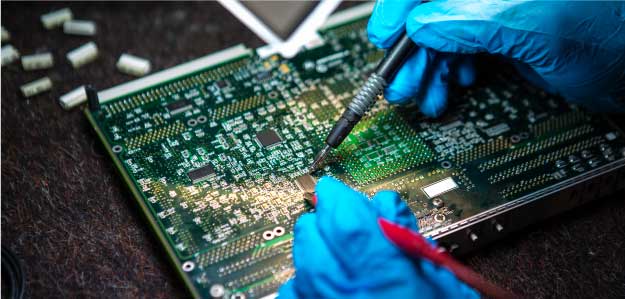
Setting up manufacturing of consumer electronics in China that combines good quality and price is challenging.
Our Recommendations for China’s Consumer Electronics Industry
a. For reducing time required in the consumer electronics industry
Intrepid Sourcing has the consumer electronics industry experience to run the process from the start. We give clients an overview of the supplier landscape, supply chains, and product alternatives so they can decide with information rather than assumptions. Our current knowledge of component prices and availability lets you reassess options quickly when something goes on allocation.
We work directly with specialised suppliers that have the capacity to fill an order of any size and implement a product idea, branding, and custom packaging to specification.
b. For ensuring quality in the consumer electronics industry
Consumer electronics contain hundreds of components and sub-assemblies with defects that are not easy to see. Intrepid Sourcing’s in-person quality assessment and control identifies flaws during development and production so that every unit ships working.
To avoid poor workmanship we assess suppliers rigorously and place projects only with factories that have supplied consumer electronics to established brands. We verify company and product certifications directly with the issuing bodies and help clients obtain the certifications their markets require, from FCC and CE to UN38.3 for batteries.
c. For reducing costs in the consumer electronics industry
Intrepid Sourcing identifies legitimate suppliers with specialised knowledge of consumer electronics production. With current knowledge of component prices and specifications, we help clients compare quotations on quality, workmanship, and cost rather than price alone, and procure critical components at fair market prices.
d. For planning in the consumer electronics industry
We streamline planning and make the process faster and more reliable for offshore clients, particularly those with no experience of Chinese suppliers. We work with PCB prototyping and product development partners to shorten prototyping, secure fair rates for components and process alternatives, and manage sample procurement within China through our own engineers, designers, and packaging providers.
e. For minimizing risk in the consumer electronics industry
Intrepid Sourcing’s in-house electronics engineers review the design and requirements before anything is committed. We assist with certification, set up production with specialised suppliers, and execute a contract under Chinese law that protects your interests. And we plan assembly location around your target markets, so tariff exposure is a decision you make deliberately rather than a surprise on the customs invoice. If you are developing an electronic product, the place to start is our electronics production package.