On this page
Finding a custom kids clothing manufacturer is the decision that determines whether a children’s brand works, and it is harder than finding a general garment factory because children’s wear carries compliance requirements that adult clothing does not. This guide covers what to look for and what disqualifies a supplier.
What a Custom Kids Clothing Manufacturer Must Have
Children’s wear experience specifically
This is the first filter and it eliminates most candidates. A factory that makes adult clothing well may not know that neck drawstrings are banned, that small parts need pull testing, or that sleepwear must be snug-fitting or flame-resistant. Ask what children’s brands they have produced for, and ask to see the test reports.
Understanding of compliance
A competent custom kids clothing manufacturer will raise CPSIA testing, tracking labels, EN 14682 cord requirements, and chemical limits before you do. One that waits to be told is one that will produce something unsaleable.
Fabric sourcing for children’s wear
Soft, durable, washable fabrics that pass chemical testing are a narrower field than general apparel fabrics. A manufacturer with established relationships in that supply chain will produce better results than one buying on the open market.
Grading across a size range
Children’s ranges span five or six sizes and body proportions change with age, so grading is not a simple scale-up. A manufacturer that grades badly produces garments that fit at the middle sizes and fail at both ends.
Assessing a Custom Kids Clothing Manufacturer
Communication. A supplier that raises problems early is worth more than one that agrees to everything. Speed and clarity of response during quoting is a reasonable predictor of behaviour during production.
Realistic minimums. Ask whether the MOQ is per style or per style per size, because a children’s order spread across six sizes is a very different commitment.
Record keeping and traceability. Required for compliance, since tracking labels must identify production batch and date. A manufacturer without systems for this cannot support a children’s product.
Sampling discipline. Expect two or three rounds and expect to pay for them. Free samples on a complex garment usually mean corners.
Capacity that matches you. Too large and you are scheduled last; too small and you outgrow them.
Red Flags
Read the description on the test report before you read the result. A passing report for plain jersey does not tell you whether the painted snap on your romper meets its applicable requirements. If we use a component report, we need to show which component it covers and where we used it.
Watch what happens when a trim goes out of stock. A replacement snap can look identical and still have a different coating or require a different setting tool. A production change record should name the replacement, identify the affected pieces, and show who approved the change.
Questions to Ask About Safety Testing
Which US requirements apply to this exact style? Give us the intended age, use, and market. For a US order, ask which requirements under the Consumer Product Safety Improvement Act (CPSIA) and related rules apply to the fabric, print, and hardware. Identify any testing exemption separately rather than assuming it covers the whole piece.
Who owns the certificate? For imported children’s products, the US importer issues the Children’s Product Certificate. Where third-party testing is required, ask which CPSC-accepted laboratory will perform each test and whether its acceptance covers that test. The importer needs access to the supporting records.
How will you assess cords for the EU? EN 14682 addresses cords and drawstrings according to the child’s age and the cord’s location. For a young child’s hood, we can shape the opening without a drawstring. Ask to see the waist and hem assessment too, since a projecting loop can catch even when the neck is clear.
Verifying a Custom Kids Clothing Manufacturer
Confirm whether your custom kids clothing manufacturer is a factory or a trading company by asking for the business licence, which states the registered scope. Verify social compliance audits, BSCI, SMETA, or WRAP, with the issuing body rather than accepting a scan. Ask directly whether any part of production is subcontracted, and put the answer in the contract, because subcontracting is where compliance most often breaks down.
What a Good First Sample Round Looks Like
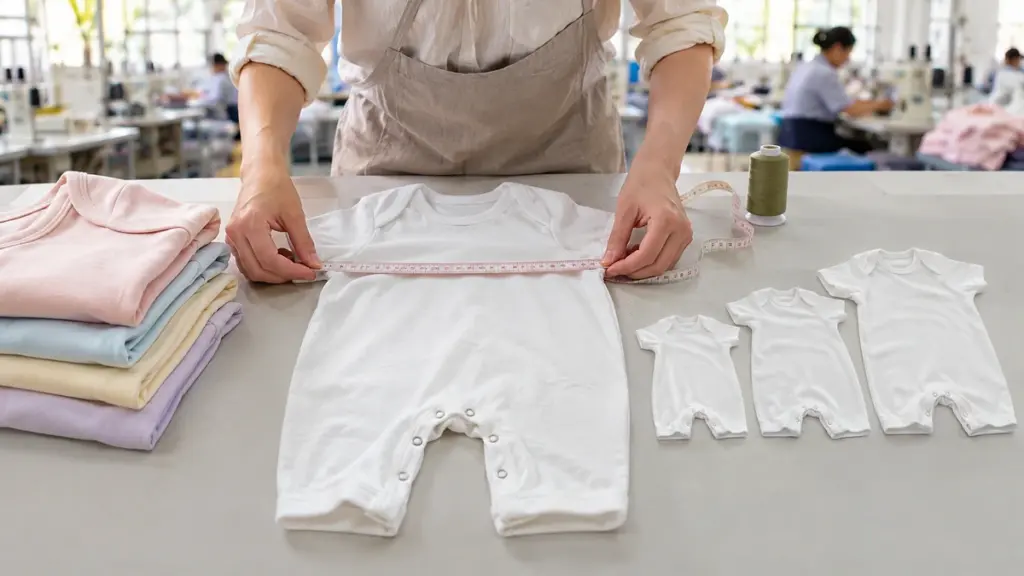
The first sample should arrive with a measurement sheet and a list of substitutions. If the zipper is longer than specified or the final elastic is unavailable, we mark the difference. You can then judge the fit without accidentally approving a temporary component.
For a toddler jacket, check whether the cuff passes over a hand and whether the zipper guard stays between the slider and the chin. Measure the same sample before and after washing. Return one set of comments that names the fault, the requested change, and the measurement we should check on the next sample.
Wrapping Up
The right custom kids clothing manufacturer has children’s wear experience, raises compliance before you do, grades properly across sizes, and communicates honestly. The wrong one produces garments that look fine and cannot legally be sold.
Finding and verifying that manufacturer, and managing sampling, testing, and production, is what our children’s clothing manufacturing service does, with quality assurance covering the safety testing.