
On this page
For most commercial imports, you need both transport arrangements and customs clearance, even if one company provides both services. The freight forwarder vs customs broker question is usually about who handles each job and what their quote includes. Appoint them before production ends so missing documents do not hold up collection.
Freight forwarder vs customs broker: assign the work
The forwarder books transport, arranges collection and coordinates cargo through the journey. The broker prepares the customs entry using the product information and commercial documents you provide. A firm offering both services should identify the team responsible for each.
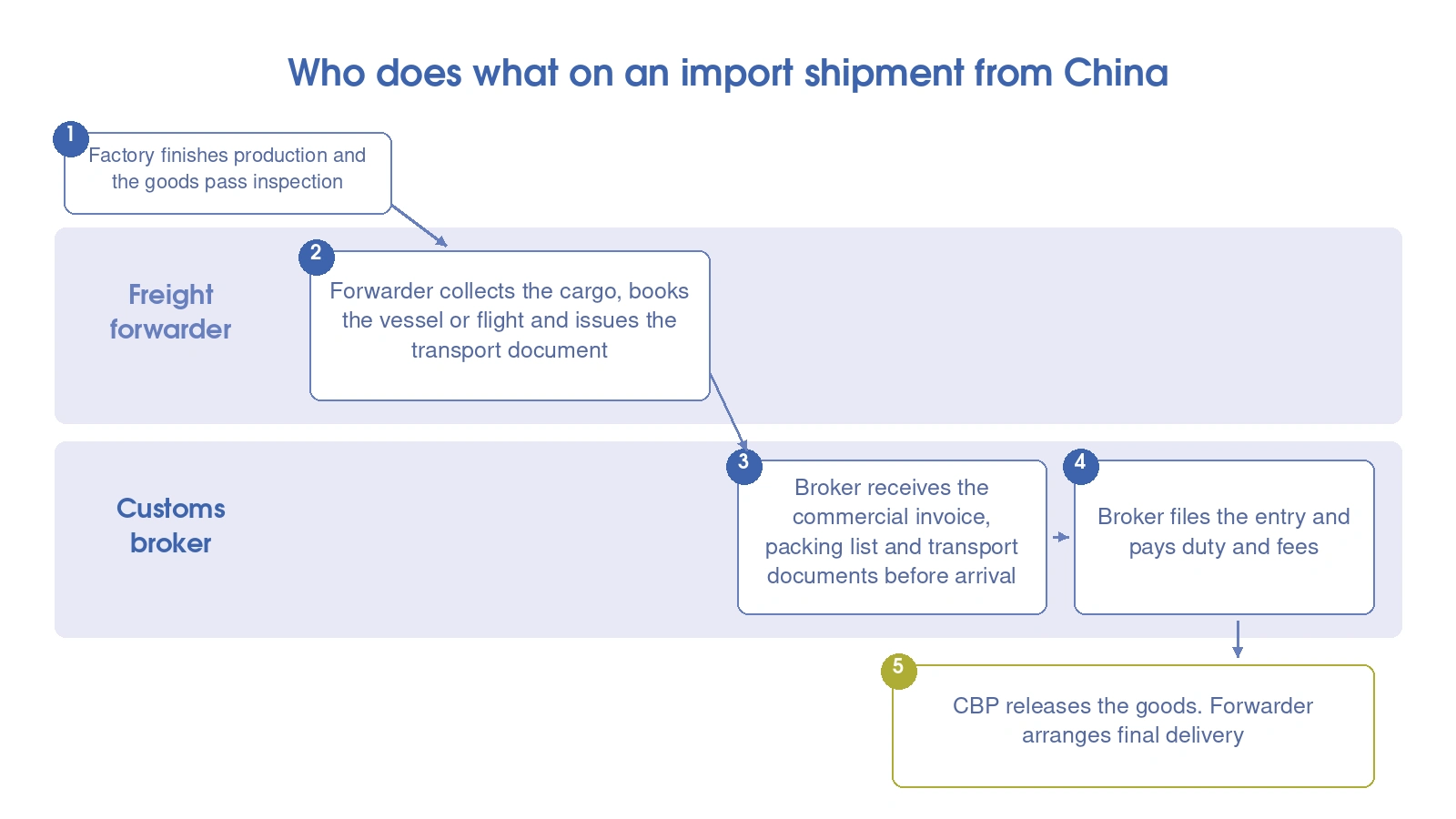
We ask for a written scope showing where each service starts and ends. “Door to door” is not enough if the quote leaves customs clearance, duties or delivery charges unclear. Ask who contacts you when customs requests more information and who coordinates the response with the factory.
A freight delay and a customs hold can overlap. Rather than arguing over which provider owns the problem, agree who monitors arrival, who files the entry and who authorizes additional costs. Put contact names on the shipment instructions.
Compare the scope before comparing the price
A low transport quote can exclude services another quote includes. We compare the same route, cargo dimensions and delivery point, then ask each provider to identify exclusions. A quote based on estimated packing should be checked again when final carton details are available.
- Origin work: Collection, export arrangements and handling before departure.
- Main transport: The booked route, transport mode and charges included in the offer.
- Destination work: Clearance, local handling and final delivery responsibilities.
- Exceptions: How storage, examinations or changed delivery instructions will be charged.
Ask which costs are estimates and which depend on events outside the provider’s control. We do not approve a comparison that treats an estimate as a fixed delivered price. The same packing specification should go to every provider quoting the shipment.
Check qualifications for the service you are buying
In US ocean trade, the Federal Maritime Commission regulates ocean transportation intermediaries. US ocean freight forwarders and US-based non-vessel-operating common carriers generally need FMC licenses and evidence of financial responsibility. Non-US firms can operate under different registration or licensing arrangements.
US customs brokers are licensed by CBP. Importers may file their own entries, but transacting customs business for others generally requires a broker license.
In the UK, customs intermediaries may represent you directly or indirectly. Ask which arrangement applies and get the instructions in writing because the responsibilities differ.
We check the actual business providing the regulated service, not assume a freight company’s marketing description proves its status. If it subcontracts clearance, ask who the broker is. That answer should be available before cargo is collected.
The importer still needs to check the entry
A broker works from the information it receives. Give it the real product description, materials and transaction details rather than relying on a short sales name. Ask it to resolve classification and value questions before arrival where possible.
In the US, appointing a broker does not remove the importer’s reasonable-care responsibilities. The broker’s authority and the identity of the importer should be clear in the paperwork.
Our recommendation is to keep one approved document set shared by the buyer, factory and logistics providers. Conflicting invoices or packing lists create avoidable questions. If an instruction changes, replace the outdated version and tell everyone what changed.
Our overseas manufacturing tips cover preparation before goods leave the factory. The sketch-to-shipment method shows where logistics decisions fit into product development. Use those milestones to assign document responsibilities while there is still time to resolve questions.
Agree the handoff before production finishes
The Incoterm helps allocate costs and responsibilities, but the named place and contract details matter. Under FOB, the buyer normally arranges main carriage. Under DDP, the seller generally takes responsibility for transport and import clearance.
For express shipments, a courier may combine movement and clearance. Ask whether the service covers your specific goods and what information it requires. Do not assume a sample shipment follows the same process as a production shipment.
- Confirm the final packing details and collection date with the factory.
- Send the invoice, packing list and product information to the responsible providers.
- Resolve classification, authorization and payment questions before collection.
- Confirm who tracks arrival and who arranges delivery after release.
We delay collection if nobody can confirm who is handling clearance or if the commercial documents disagree. Freight and brokerage should already be included in the project’s cost estimate. Our find a manufacturer service helps coordinate the product information and factory preparation needed before shipping.
Enjoying this guide?
Practical manufacturing guidance for product brands. Factory selection, costs, quality and protecting your designs.