
Small quantity clothing manufacturers in China take orders that large factories turn away. They exist, they can be useful, and they come with trade-offs a new brand should understand before choosing one. This guide explains where minimums come from, what a small run really costs, and when a larger first order is the better decision.
It also covers how to check a small factory before you pay a deposit, and how our own clothing production works.

Why Clothing Factories Set Minimums
An MOQ is rarely about the sewing. It usually comes from two places.
- The fabric mill. Mills sell fabric by the roll or by a minimum dye lot for each colour. The factory has to buy that quantity even if your order needs less.
- Line setup. Cutting patterns, setting up machines and training operators on a new style takes the same time for a short run as for a long one.
So the useful question to a factory is not “can you lower your MOQ”. It is “whose minimum is this”. A fabric minimum can sometimes be solved with a stock fabric the mill already holds. A setup minimum usually cannot.
What Small Quantity Clothing Manufacturers in China Offer
Small quantity clothing manufacturers in China are usually smaller workshops or sample rooms. They accept short runs because their overheads are lower and their lines are set up for frequent changes.
- A lower first commitment. You put less cash into stock before you know what sells.
- Room to test. You can try a style or a colour before committing to a full range.
- Attention. A small workshop will often engage closely with a small order.
The Trade-Offs of Small Quantity Clothing Manufacturers in China
The lower commitment has a price. Brands working with small quantity clothing manufacturers in China often find out after the first order.
- Higher unit cost. Setup, sampling and fabric minimums are spread across fewer pieces. Every unit carries more of that cost.
- Fabric limits. You are often restricted to stock fabrics and stock colours. Custom dyeing and custom fabrics bring the mill minimum back.
- Lower priority. A short run is easy to push down the schedule when a larger order arrives.
- Weaker controls. Smaller workshops may not have the inspection routines, audits or paperwork that larger buyers expect.
- Scale risk. A workshop that handles a short run comfortably may not cope with a bulk reorder. Moving factories later means new samples, new fit approvals and a product that shifts slightly.
When a Larger First Order Makes More Sense
For a product you plan to sell for more than one season, a larger first run often costs less overall. Unit prices fall. Fabric and colour choices open up. Freight, inspection and clearance costs are paid once instead of several times. We set out the full comparison in our article on why chasing the lowest MOQ can cost you more.
The question to ask is not “what is the lowest MOQ”. It is “how many units can I sell before I need to reorder”. If the honest answer is well below a factory’s minimum, keep developing and sampling before you place a production order.
How to Check Small Quantity Clothing Manufacturers in China
The checks for small quantity clothing manufacturers in China are the same as for any supplier. They matter more with small workshops because controls vary widely.
- Factory or trading company. Ask where the sewing happens and visit or audit that site.
- Comparable work. Ask to see garments with the same construction and fabric weight as yours.
- Social compliance. Ask for a current social audit such as SMETA, which covers labour standards and health and safety.
- Inspection. Confirm the factory accepts third-party inspection before the final payment.
- Capacity. Ask about maximum output at the same time as the minimum, so you know whether the factory can grow with you.
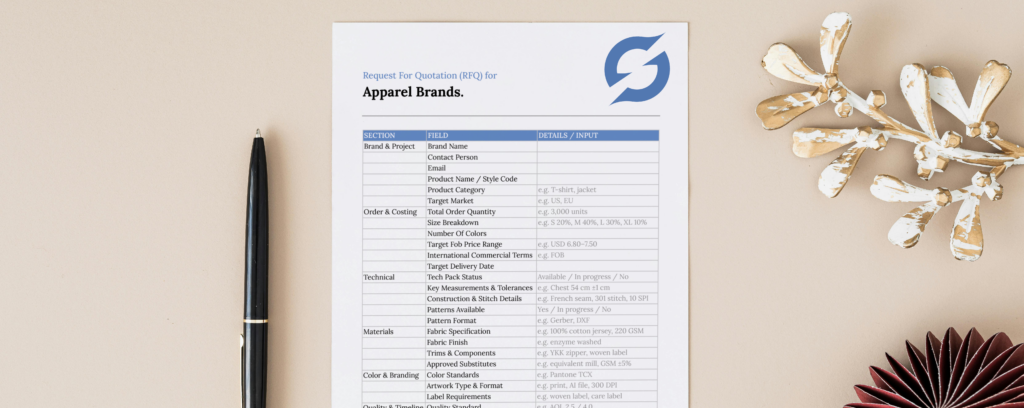
A complete tech pack helps any factory quote accurately. It also makes it easier to move production later if you need to.
How Our Clothing Production Works
Our clothing production starts at 1,000 pieces per style and colour, and sizes share that quantity. That level lets us use established factories in China, Vietnam and Bangladesh, choose from a wider range of fabrics, and run proper sampling and inspection before you pay the balance.
If you are not ready for that quantity yet, start with the design and sampling stages. You can move into production when your numbers support it.
See how our clothing manufacturing service runs from tech pack to delivery.