
This quality assurance guide covers what a brand needs to do to make sure the goods that arrive match the goods that were ordered. It is written for someone having a product made by a factory, usually overseas, where you cannot walk the floor yourself and where a defective shipment is discovered thousands of miles from the people who made it.
The first thing to settle is a distinction that gets blurred constantly. Quality control is inspection: checking finished goods and rejecting the bad ones. Quality assurance is the process that stops bad goods being made in the first place: specifications, approved samples, controlled processes, and checks at each stage. Control finds defects. Assurance prevents them. You need both, and a supplier that only offers the first is offering you a filter, not a system.
Quality Assurance Guide: Start With the Specification
Every quality assurance guide should start here, because nearly every quality dispute traces back to a specification that was not precise enough to enforce. If the contract says “high quality cotton,” there is nothing to argue with when the fabric disappoints. If it says a specific fabric weight, composition, colour standard, and shrinkage tolerance, there is.
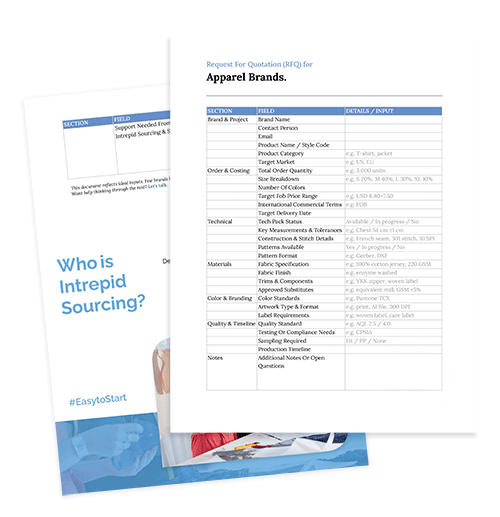
A usable specification covers materials and grades, dimensions and tolerances, construction method, finish, colour references, labelling and packaging, and the standards the product must meet in its destination market. For garments this is the tech pack; for moulded parts it is the drawing and material callout; for electronics it is the bill of materials and test criteria.
Write it before quoting, not after. A quote given against a vague description will be re-quoted once the factory understands what you actually want, and by then you have lost your negotiating position.
Quality Assurance Guide: The Golden Sample
Once a pre-production sample is approved, it becomes the reference every later decision is measured against. Sign it, seal it, and keep one copy with the factory and one with you. Reference it in the purchase contract as the quality standard.
The golden sample is what settles disputes. If a shipment differs from it, the shipment is at fault; if the sample was approved with a flaw, you accepted that flaw. This single practice prevents more argument than anything else in this quality assurance guide, and it costs nothing but attention at the right moment.
Quality Assurance Guide to Inspection Stages
In this quality assurance guide, inspection is not treated as one event. There are four points where it is worth doing, and skipping the early ones is what makes the late ones expensive.
Pre-production inspection checks materials and components before assembly starts. Catching wrong fabric or substituted components here costs a delay; catching it after production costs the run.
During-production inspection, usually when 20% to 30% of the order is complete, catches systematic errors while there is still time to correct them. This is the most valuable inspection and the one most often skipped.
Pre-shipment inspection samples finished goods against the golden sample and the specification, and is the last chance before the goods are yours.
Container loading supervision confirms that what was inspected is what gets loaded, in the right quantity and packed correctly. It matters more than it sounds for high-value goods.
Quality Assurance Guide to AQL Sampling
Inspectors do not check every unit; they check a statistically determined sample under the AQL standard, ISO 2859-1. The AQL number is the maximum proportion of defective units at which a batch is still accepted, and defects are classified in three tiers:
- Critical: renders the product unsafe or unsaleable, or breaches a regulation. Standard AQL is 0.
- Major: affects function or appearance in a way a customer would reject. Common AQL is 2.5.
- Minor: a deviation a customer would probably accept. Common AQL is 4.0.
Agree the AQL levels in the contract before production, not when the inspection report arrives. A supplier who has agreed to 2.5 major has accepted a defined standard; one who has not will argue about what counts as a defect at exactly the moment you have no leverage left.
Quality Assurance Guide: Factory Audits
A quality assurance guide that stops at product inspection misses half the picture. An audit assesses the factory rather than the goods, and it answers questions a product inspection cannot: whether the equipment matches the claims, whether the workforce is the size stated, whether there is a documented quality system, and whether the factory subcontracts work it says it does in-house.
Two kinds matter. A technical audit covers capability, equipment, process control, and quality systems such as ISO 9001. A social compliance audit, BSCI, SMETA, WRAP, or SA8000, covers working hours, wages, safety, and forced or child labour. Since 2024 the second has become a legal requirement rather than an ethical preference for anyone selling into the EU, where supply chain due diligence obligations now apply.
Quality Assurance Guide: Laboratory Testing
The part of any quality assurance guide people skip: some quality attributes cannot be seen, and these are the ones that generate recalls. Plating thickness, nickel release, lead and cadmium content, formaldehyde in textiles, colourfastness, flammability, and battery safety all require laboratory testing by an accredited lab.
Which tests apply depends on the product and the market: CPSIA for children’s products in the US, REACH restrictions in the EU, RoHS for electronics, food-contact regulations for anything touching food. Plan testing alongside development rather than after it, because a failed test means a design change and a retest, and there is rarely slack in a production schedule to absorb that.
Measuring the Production Line
For ongoing production, a quality assurance guide should include measurement. Two metrics tell you whether a factory is genuinely under control. Overall Equipment Effectiveness multiplies availability, performance, and quality into a single number: a machine running 90% of scheduled time, at 95% of rated speed, producing 99% good parts scores about 85%. Overall Resource Effectiveness extends the same idea to labour and materials.
You will rarely get these figures from a small factory, and that is informative in itself. A supplier that measures its own yield and can tell you the number is running a controlled process. One that cannot is running on habit, and habits vary between shifts and between the order they showed you and yours.
Quality Assurance Guide to Payment Leverage
The most effective quality assurance tool available to a buyer is not technical. It is making the final payment conditional on passing pre-shipment inspection.
The standard structure is 30% deposit and 70% on completion. Paying that balance before inspection leaves you with defective goods and no recourse; making it conditional gives the factory a direct financial reason to produce what was agreed. Factories generally run on thin margins and cannot afford to scrap a batch or dump it domestically, so the condition works. Put it in the contract, because raising it after production has started is a negotiation you will lose.
Quality Assurance Guide: Logistics and Packaging
A quality assurance guide has to cover what happens after inspection: goods can pass and still arrive damaged. Packaging is the usual cause, and for e-commerce products, where a carton is handled far more roughly than a pallet delivered to a store, it is worth testing packaging by shipping it rather than by looking at it. A drop test on a packed carton catches problems that inspecting the product alone will not.
Storage conditions matter too. Solid wood moves with humidity, adhesives fail at container temperatures, and some plastics degrade under UV. If the product is sensitive, the specification should say so and the inspection should check it.
Putting the Quality Assurance Guide Into Practice
The sequence that works: write a specification precise enough to enforce, approve and seal a golden sample, agree AQL levels in the contract, audit the factory before placing work, test in an accredited lab for anything regulated, inspect during production rather than only at the end, and hold the final payment until inspection passes.
None of it is complicated. What makes quality fail is compressing the schedule and dropping steps, almost always the during-production inspection and the lab testing, which are the two that catch problems while they can still be fixed.
Running that process on a client’s behalf, from specification through factory audit to pre-shipment inspection, is what our quality assurance service does, and it sits alongside product sourcing on every order we manage.